Chhattisgarh Emerges as Inland Tilapia Export Hub as Government Pushes Cluster-Based Fisheries Growth
Over 1,300 stakeholders join Raipur review; 34 fisheries clusters being developed to strengthen production, processing, value addition and seafood exports Raipur, August 20, 2026: Chhattisgarh is emerging as a new hub for export-oriented inland fisheries, with
Over 1,300 stakeholders join Raipur review; 34 fisheries clusters being developed to strengthen production, processing, value addition and seafood exports
Raipur, August 20, 2026: Chhattisgarh is emerging as a new hub for export-oriented inland fisheries, with the Centre outlining a roadmap to scale up Tilapia production, processing and international market access through a cluster-based development model.
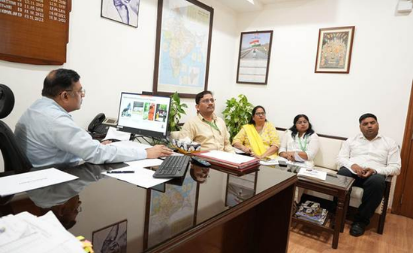
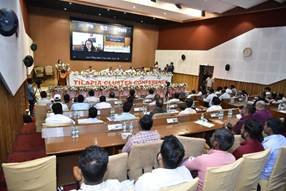
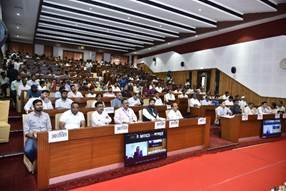
Dr. Abhilaksh Likhi, Secretary, Department of Fisheries, chaired an interaction with Tilapia farmers, entrepreneurs, exporters and other value-chain stakeholders in Raipur on August 20 to review the State’s Tilapia Cluster notified under the Pradhan Mantri Matsya Sampada Yojana (PMMSY).
More than 1,300 Tilapia farmers and fisheries stakeholders participated in the hybrid meeting.
5
Key Highlights
- 34 fisheries clusters are being developed as growth engines for production, processing and exports.
- Chhattisgarh has already exported 382 tonnes of Tilapia to the United States.
- The State’s Tilapia production is reported at nearly 25,000 tonnes.
- India exported 22,601 tonnes of Tilapia worth ₹189.73 crore in FY2025-26.
- More than 1,300 farmers and value-chain stakeholders participated in the Raipur interaction.
- Nearly ₹900 crore has been invested under PMMSY in Chhattisgarh, according to the Department of Fisheries.
- The government is pushing for stronger cold chains, processing, quality assurance, technology adoption and market linkages.
From Inland Fish Production to Export-Oriented Clusters
The Centre’s cluster-based strategy seeks to move fisheries beyond primary production by integrating farming, seed, feed, processing, cold chain, quality certification and market access.
Dr. Likhi said notified fisheries clusters would receive end-to-end support across the value chain to improve competitiveness and boost exports.
The approach is particularly relevant for inland States such as Chhattisgarh, where freshwater resources can support large-scale aquaculture without dependence on coastal fisheries.
The Department has identified 34 fisheries clusters as potential growth engines, with Chhattisgarh’s Tilapia cluster among the emerging examples.
Chhattisgarh’s Tilapia Production Expands
According to the Department, investments of nearly ₹900 crore under PMMSY in Chhattisgarh have supported quality seed, feed and modern aquaculture technologies, contributing to a substantial increase in the State’s fish production.
Tilapia production in the State is now reported at approximately 25,000 tonnes.
The government sees the species as particularly suitable for an export-oriented model because of its adaptability to aquaculture systems and strong international demand.
Chhattisgarh has already taken the first step into overseas markets, with 382 tonnes of Tilapia exported to the United States.
India’s Tilapia Exports Show Further Potential
India exported 22,601 tonnes of Tilapia valued at ₹189.73 crore in FY2025-26, making it the country’s largest freshwater finfish export by volume, according to the Department.
Overall exports of identified freshwater/inland species stood at 32,324 tonnes worth ₹535.21 crore during the same period.
Despite this growth, India’s share of the global Tilapia market remains relatively small.
The government therefore sees significant potential to expand exports of frozen fillets and value-added Tilapia products, particularly as international demand grows across Africa, Europe and Asia.
MM Hatcheries Gets Support for Quality Tilapia Seed
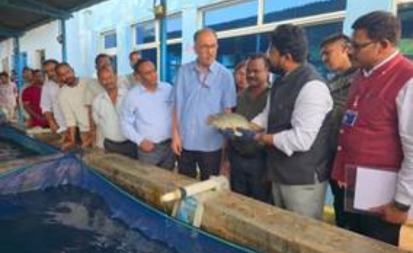
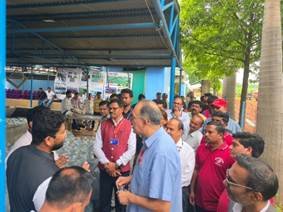
During his Chhattisgarh visit, Dr. Likhi also visited MM Hatcheries in Mana, Raipur, which specialises in Tilapia seed production and genetic improvement.
The hatchery is working on genetically improved black-strain Tilapia, with the objective of improving seed quality, productivity and farm performance.
It has received:
- ₹5 crore under the Entrepreneurship Model of PMMSY
- ₹35 lakh Performance Grant under PM-MKSSY
The hatchery supplies Tilapia seed across India and has contributed to the development of Chhattisgarh’s expanding Tilapia farming ecosystem.
Farmers Seek Lower Production Costs and Easier Credit
Despite the growth potential, farmers identified several barriers that could limit the competitiveness of the cluster.
Key concerns included:
- Availability of quality seed
- High production costs
- Water rent charges
- Rising electricity costs
- Limited access to institutional credit
- Complex bank financing procedures
- Lack of adequate domestic market absorption
- Export certification and international standards
- Need for technical training and capacity building
Small and tribal fish farmers were identified as needing particular support in modern production techniques, integrated fish farming, export certification and international market requirements.
Stakeholders also called for exchange programmes, international exposure visits and technology collaborations.
Common Facility Centre Proposed
Industry and government stakeholders stressed the need for a Common Facility Centre (CFC) within the Tilapia cluster.
Such a facility could provide smaller farmers access to shared infrastructure for:
- Fish processing
- Filleting
- Packaging
- Cold storage
- Quality testing
- Value addition
- Waste utilisation
The move could help address one of the central challenges facing small-scale producers: the inability to independently invest in sophisticated processing and export infrastructure.
Stakeholders also called for greater use of circular-economy practices to utilise aquaculture waste and improve the sustainability of the cluster.
Technology and Biosecurity to Shape Future Growth
The Centre is encouraging adoption of technologies including IoT, biofloc and Recirculatory Aquaculture Systems (RAS).
Dr. J.K. Jena, Deputy Director General (Fisheries Science), ICAR, emphasised the importance of quality seed and biosecurity for developing disease-free and sustainable Tilapia production.
Technology adoption is expected to become increasingly important as farmers move towards controlled production systems and export-oriented quality standards.
Export Roadmap for Chhattisgarh
The Department has called for closer coordination between the State Government, farmers, ICAR institutes, NFDB, MPEDA, NABARD, cooperatives and exporters.
MPEDA has also been urged to expand its presence in Chhattisgarh to support market access, export promotion and international exposure.
The proposed roadmap is expected to focus on:
Quality seed → scalable production → processing → cold chain → certification → value addition → export markets
This integrated model could help Chhattisgarh move from selling raw fish at farm-gate prices towards higher-value processed seafood products.
Hospitality and Tourism Impact
The development of an export-oriented Tilapia cluster also has implications for India’s hospitality and food economy.
For hotels and restaurants: Increased domestic Tilapia production and improved cold-chain systems could provide more consistent supplies of fresh and processed fish.
For food processing: Common processing facilities could encourage the development of fillets, ready-to-cook products and other value-added seafood formats.
For culinary tourism: Chhattisgarh’s growing freshwater fisheries ecosystem could support local seafood-focused culinary experiences and destination food products.
For rural tourism: Large-scale aquaculture clusters can potentially support farm visits, fisheries education and agri-aquaculture tourism when developed responsibly.
For seafood exports: Value-added Tilapia could diversify India’s seafood export basket beyond its traditional dependence on shrimp and marine products.
Bottom Line
Chhattisgarh’s Tilapia cluster represents a significant shift in India’s inland fisheries strategy—from fish production to integrated, export-oriented value chains.
With 34 clusters being developed nationally, stronger processing and cold-chain infrastructure, improved seed technology and greater access to international markets, inland fisheries could become an increasingly important contributor to India’s seafood exports, rural employment and Blue Economy.