India Develops Indigenous African Swine Fever Vaccine, Strengthening Pig Farming and Food-Supply Biosecurity
ICAR-NIHSAD’s new live attenuated ASF vaccine could reduce pig mortality, protect farmer livelihoods and improve resilience across India’s pork supply chain Key Highlights ICAR-NIHSAD, Bhopal, develops India’s first indigenous African Swine Fever (ASF) vaccine. Vaccine uses the widely
ICAR-NIHSAD’s new live attenuated ASF vaccine could reduce pig mortality, protect farmer livelihoods and improve resilience across India’s pork supply chain
Key Highlights
- ICAR-NIHSAD, Bhopal, develops India’s first indigenous African Swine Fever (ASF) vaccine.
- Vaccine uses the widely available MA-104 cell line, reducing dependence on proprietary manufacturing platforms.
- Field validation has established its safety and efficacy under field conditions.
- ASF has caused significant livestock and livelihood losses, particularly in India’s North-East.
- The vaccine could strengthen pork supply stability and support the food and hospitality supply chain.
India has developed its first indigenous vaccine against African Swine Fever (ASF), marking a significant development for the country’s livestock sector and strengthening its broader food-supply and biosecurity framework.
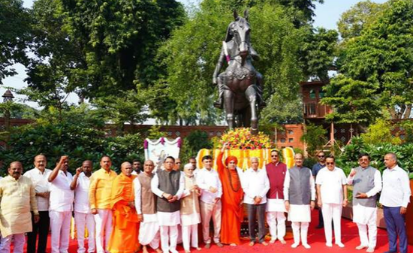
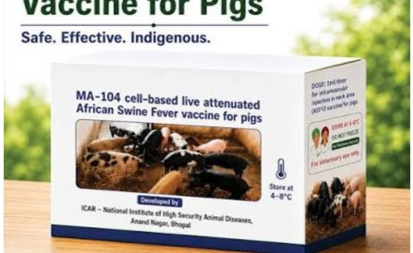
Scientists at ICAR–National Institute of High Security Animal Diseases (ICAR-NIHSAD), Bhopal, have developed a MA-104 cell line-based live attenuated ASF vaccine for pigs. The vaccine was dedicated to the nation by Union Agriculture Minister Shivraj Singh Chouhan, in the presence of Union Minister Rajiv Ranjan Singh, during this year’s ICAR Foundation Day.
The development is particularly significant for India’s pig farming sector, where ASF outbreaks have caused substantial animal mortality, production disruptions and financial losses.
ASF has caused major losses in India
African Swine Fever is a highly destructive viral disease affecting domestic and wild pigs. It can result in mortality rates approaching 100% and has become a major threat to pig production globally.
India first detected ASF in 2020, after which the disease spread to several States and Union Territories. The outbreaks have resulted in pig deaths, culling, restrictions on animal movement and trade, and significant livelihood losses among smallholder farmers.
The North-Eastern region has been particularly affected.
During ASF outbreaks in Assam in 2020 and 2021, pig mortality and culling resulted in estimated losses of around ₹276 crore. In Mizoram, outbreaks reportedly affected more than 11,382 households up to 2025, with estimated financial losses of approximately ₹982 crore.
Until now, the absence of an effective treatment and a commercially approved ASF vaccine in India has meant that disease management has largely depended on rapid diagnosis, culling and strict biosecurity measures.
Indigenous vaccine designed for large-scale production
The vaccine developed by ICAR-NIHSAD uses a novel attenuated ASF virus Genotype II strain with specific gene deletions, produced using the MA-104 cell line.
According to the government, the vaccine has undergone extensive laboratory evaluation covering sterility, purity, safety, genetic stability, immunogenicity, protective efficacy and virulence reversion.
It has also been field validated in collaboration with the Department of Animal Husbandry & Dairying (DAHD).
The vaccine is recommended for healthy pigs above eight weeks of age. It is administered through a 1 mL intramuscular injection, followed by a booster dose 14 days after the primary vaccination.
MA-104 technology could lower manufacturing dependence
A key advantage of the Indian vaccine is its manufacturing platform.
Currently, only a limited number of commercially licensed ASF vaccines are available globally, with Vietnam having commercially licensed vaccines produced using patented proprietary cell lines.
The ICAR vaccine instead uses the widely available MA-104 cell line. This could reduce dependence on proprietary manufacturing technologies and make large-scale domestic production more feasible while lowering manufacturing costs.
The development therefore represents not only a veterinary-health milestone but also an important step towards greater self-reliance in animal vaccine manufacturing.
What the ASF vaccine means for food and hospitality
The impact of ASF extends beyond pig farmers and the livestock industry.
For the food and hospitality sector, a more effective mechanism to control ASF could contribute to greater stability in the domestic pork supply chain. Pig mortality and movement restrictions can disrupt the availability and distribution of pork, particularly in regions where pork is an important part of the local food economy.
Improved disease control could help:
- strengthen the availability and continuity of domestic pork supplies;
- reduce production shocks for pork processors and meat businesses;
- support restaurants and hotels that serve pork-based dishes;
- protect livelihoods connected to pig farming, meat processing and distribution; and
- improve resilience in food supply chains in the North-Eastern states.
For travel and tourism, the implications are particularly relevant in destinations where pork is closely connected with regional cuisine and culinary tourism. Greater livestock-health resilience can support local food ecosystems that supply hotels, restaurants and tourism businesses.
A step towards stronger animal and food security
The government expects the indigenous vaccine to reduce pig mortality, minimise economic losses and improve the livelihoods of pig farmers.
Dr. M.L. Jat, Secretary, DARE and Director General, ICAR, described the development as a significant milestone in veterinary science, highlighting its potential to strengthen livestock health, disease preparedness and India’s wider food and biosecurity systems.
For India’s hospitality and food ecosystem, the development is important because animal health is increasingly linked to food security, supply-chain resilience and the stability of regional culinary economies.
The indigenous ASF vaccine could therefore become an important tool in protecting India’s pig population while supporting the wider network of farmers, processors, food businesses, hotels and restaurants dependent on a reliable pork supply.