Centre Unveils Roadmap to Revive Totapuri Mango Value Chain; Pushes for 22–25% Real Mango Pulp in Beverages
Union Agriculture Minister Shivraj Singh Chouhan announces measures to support Totapuri mango farmers through value addition, processing reforms, exports and quality improvements across Andhra Pradesh, Tamil Nadu and Karnataka Key Highlights Centre reviews challenges faced by Totapuri
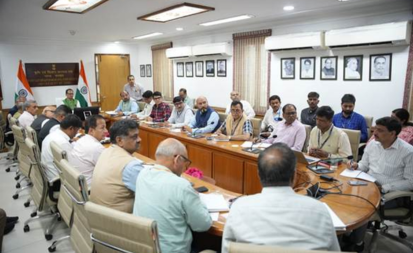
Union Agriculture Minister Shivraj Singh Chouhan announces measures to support Totapuri mango farmers through value addition, processing reforms, exports and quality improvements across Andhra Pradesh, Tamil Nadu and Karnataka
Key Highlights
- Centre reviews challenges faced by Totapuri mango farmers in Andhra Pradesh, Tamil Nadu and Karnataka.
- High-level expert committee conducted field visits to orchards, mandis and processing units before submitting recommendations.
- Government recommends 22–25% real mango pulp in mango-based beverages to boost demand for natural pulp.
- Inter-ministerial consultation proposed involving FSSAI, GST Council, Ministry of Finance, Ministry of Food Processing Industries, Ministry of Agriculture and Ministry of Health.
- Proposal to establish a Central Coordination and Price Stabilisation Committee for the Totapuri value chain.
- Focus on rejuvenating ageing orchards through top-working with premium mango varieties.
- Government recommends zonal procurement planning, mandatory early-season procurement and stronger Farmer Producer Organisation (FPO) participation.
- APEDA to strengthen domestic and international market access, including expansion of sea-route exports.
Centre Announces Comprehensive Plan to Strengthen Totapuri Mango Value Chain
Responding to concerns over falling prices and declining incomes of Totapuri mango growers, the Government of India has unveiled a comprehensive strategy aimed at strengthening cultivation, processing, marketing and exports of one of the country’s most important processing mango varieties.
Union Agriculture and Farmers’ Welfare Minister Shivraj Singh Chouhan chaired a high-level review meeting in New Delhi after receiving the report of an expert committee constituted earlier this month to examine the challenges affecting Totapuri mango farmers in Andhra Pradesh, Tamil Nadu and Karnataka.
The committee—comprising experts from the Indian Council of Agricultural Research (ICAR), the Central Institute for Subtropical Horticulture (CISH), the Indian Institute of Horticultural Research (IIHR), Dr. YSR Horticultural University and State horticulture departments—visited orchards, wholesale markets, processing factories and interacted with farmers, exporters and Farmer Producer Organisations (FPOs) before submitting its recommendations.
22–25% Real Mango Pulp Proposed for Mango-Based Beverages
One of the most significant recommendations emerging from the review is to make 22–25% real mango pulp mandatory in mango-based beverages.
The committee observed that lower pulp content in processed drinks has reduced industrial demand for Totapuri mangoes, impacting farmer incomes. It suggested retaining beverages with higher natural pulp content under the 5% GST slab, while applying higher tax rates to products containing lower quantities of real fruit pulp.
The Agriculture Minister directed officials to convene an inter-ministerial meeting involving the Food Safety and Standards Authority of India (FSSAI), GST Council, Ministry of Finance, Ministry of Food Processing Industries, Ministry of Agriculture, and the Ministry of Health to examine the proposal and develop an appropriate regulatory framework.
Price Stabilisation and Better Procurement Planning
To minimise seasonal price crashes, the expert committee recommended the formation of a Central Coordination and Price Stabilisation Committee.
The proposed body would review crop estimates, processing demand, export requirements, production costs and market conditions before every mango season. It would also provide indicative farm-gate procurement prices and reference pulp prices to improve market transparency for both growers and processors.
The committee also recommended that the Andhra Pradesh Government introduce a Standard Operating Procedure (SOP) requiring registered processing units to begin procurement and pulp production from May 15 every year to avoid delays that often lead to oversupply in mandis and falling prices.
Focus on Orchard Rejuvenation and Value Addition
A significant portion of Totapuri orchards in Chittoor, Tirupati, Annamayya and Kadapa consists of ageing plantations with declining productivity.
To improve yields and fruit quality, the committee proposed top-working, a horticultural technique that grafts premium mango varieties such as Alphonso, Banganapalli, Himayat and Neelam onto existing trees, allowing farmers to obtain higher-value harvests within two to three years.
Additional recommendations include:
- Cluster-based implementation of Good Agricultural Practices (GAP).
- Distribution of fruit bags across approximately 23,333 hectares to improve fruit quality and reduce pest damage.
- Development of zonal procurement systems involving horticulture departments, processors and FPOs.
- Promotion of farmer-led processing units using technologies developed by ICAR for products such as mango butter derived from mango seed kernels.
Exports and Market Expansion in Focus
The Agricultural and Processed Food Products Export Development Authority (APEDA) highlighted efforts to expand both domestic and international demand for Totapuri mangoes, with particular emphasis on cost-effective sea-route exports.
The Agriculture Minister said the Centre would work with APEDA, ICAR and State Governments to develop an integrated export and marketing strategy covering fresh Totapuri mangoes as well as processed pulp and value-added products.
He emphasised that future policy would be farmer-centric and involve coordinated action by Central and State Governments, research institutions, FPOs and the food processing industry.
Hospitality, Food & Tourism Impact
The proposed reforms could have far-reaching implications for India’s hospitality, food processing and culinary tourism sectors.
- Hotels, restaurants, cafés and beverage brands could benefit from higher-quality Totapuri pulp, supporting premium mango-based desserts, beverages, smoothies, ice creams and seasonal menus.
- A mandate for 22–25% real mango pulp would encourage the food and beverage industry to use more natural fruit, improving product quality and enhancing consumer trust.
- Stronger procurement systems and value-chain coordination can stabilise mango availability and pricing for hospitality businesses during the peak season.
- Expansion of processing and exports will strengthen India’s reputation as a leading global mango producer, supporting food exports, gastronomic tourism and destination branding.
- Orchard rejuvenation and FPO-led value addition can create opportunities for agritourism, mango festivals, orchard experiences and regional culinary tourism in southern India.
Hospitality Outlook
The Centre’s proposed overhaul of the Totapuri mango ecosystem is more than an agricultural intervention—it is a strategic boost for India’s food and beverage industry. By improving fruit quality, strengthening processing capacity, encouraging natural fruit usage in beverages and expanding export opportunities, the initiative can benefit hotels, restaurants, processors and tourism stakeholders while reinforcing India’s position as a global destination for mango-based culinary experiences.