India Strengthens Dairy and Livestock Sector with Focus on Infrastructure, Exports and Farmer Support
Government highlights 70% growth in milk production over the past decade, expands dairy infrastructure and reinforces support through flagship livestock schemes. Key Highlights India's milk production has increased 70% to nearly 248 million tonnes over the past
Government highlights 70% growth in milk production over the past decade, expands dairy infrastructure and reinforces support through flagship livestock schemes.
Key Highlights
- India’s milk production has increased 70% to nearly 248 million tonnes over the past decade.
- Egg production has grown 90%, reaching 149.11 billion annually.
- Government says no national livestock law is under consideration as animal husbandry remains a State subject.
- Dairy infrastructure continues to expand through NPDD and AHIDF.
- Bharat Pashudhan database to improve livestock traceability and boost exports.
- India remains self-sufficient in milk production, with output exceeding projected domestic demand.
India reinforces investment in dairy and livestock sector
The Government of India has reaffirmed its commitment to strengthening the country’s dairy and livestock sectors through sustained investments in infrastructure, disease control, genetic improvement, value-chain development and export promotion.
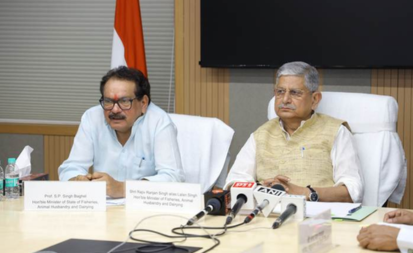
Replying to questions in the Rajya Sabha, the Ministry of Fisheries, Animal Husbandry and Dairying said that while animal husbandry remains a State subject under Article 246(3) of the Constitution, the Centre continues to support States and Union Territories through a range of flagship programmes aimed at improving productivity, farmer incomes and rural livelihoods.
The government clarified that there is no proposal to introduce a comprehensive National Livestock Development legislation or policy framework, with legislative responsibility resting with individual states.
Milk and egg production record strong growth
The Ministry highlighted significant progress achieved by the livestock sector over the last decade.
India’s milk production has increased by 70%, rising from 146.31 million tonnes in 2014-15 to nearly 248 million tonnes in 2024-25.
Egg production has also recorded robust growth, increasing 90% from 78.48 billion eggs to 149.11 billion during the same period.
According to the government, these gains have been supported through flagship initiatives including:
- Rashtriya Gokul Mission (RGM)
- National Livestock Mission (NLM)
- Livestock Health and Disease Control Programme (LHDCP)
- National Programme for Dairy Development (NPDD)
- Animal Husbandry Infrastructure Development Fund (AHIDF)
India remains self-sufficient in milk production
The Ministry informed Parliament that India continues to produce enough milk to meet domestic demand.
Citing the NITI Aayog Working Group Report on Crop Husbandry, Agriculture Inputs, Demand & Supply (2024), the government said projected milk demand for 2025-26 stands at 243 million tonnes, while actual production during 2024-25 reached 247.87 million tonnes.
The figures indicate that India remains self-sufficient in milk and dairy products despite growing consumption.
Focus on modern dairy infrastructure
To strengthen dairy value chains, the government continues to expand investment in milk procurement, processing, chilling and cold-chain infrastructure.
Under the National Programme for Dairy Development (NPDD), financial assistance includes:
- 50% grant support for strengthening milk procurement, chilling and quality assurance infrastructure.
- 75% Central grant for milk procurement, processing, value addition and cold-chain projects in hilly and North Eastern states.
- 70% Central assistance for dairy quality assurance infrastructure in these regions.
Meanwhile, the Animal Husbandry Infrastructure Development Fund (AHIDF) offers 3% interest subvention to eligible beneficiaries for establishing modern dairy processing, value addition and cold-chain facilities across both cooperative and private sectors.
Livestock traceability and exports receive attention
The government is also focusing on improving export competitiveness through better livestock traceability.
A key initiative is the Bharat Pashudhan database, developed jointly by the Department of Animal Husbandry and Dairying (DAHD) and the National Dairy Development Board (NDDB). Based on a unique 12-digit animal identification system, the platform aims to strengthen traceability while supporting exports of value-added livestock products.
The Ministry said it is also working with the Agricultural and Processed Food Products Export Development Authority (APEDA) and the Export Inspection Council (EIC), while engaging with partner countries through bilateral mechanisms to improve international market access for Indian dairy products.
Government continues support for farmers
According to the Ministry, ongoing investments in livestock infrastructure, disease-free zones, animal health, genetics and value-chain development are intended to improve productivity, generate employment and strengthen rural incomes.
The government said continued collaboration with State Governments will remain central to expanding India’s livestock and dairy sector while supporting nutritional security and export growth.
Hospitality & Tourism Impact
The continued expansion of dairy processing capacity, cold-chain infrastructure and livestock productivity is expected to benefit India’s hospitality and foodservice sectors by improving the availability, quality and consistency of milk and dairy products for hotels, restaurants, cafés and institutional catering.
Enhanced traceability through the Bharat Pashudhan database and greater investment in modern processing infrastructure could also strengthen consumer confidence, support premium dairy offerings and improve export opportunities for value-added dairy products. For the hospitality industry, a stronger domestic dairy ecosystem contributes to more reliable sourcing of milk, cheese, butter, yoghurt and other dairy ingredients that underpin India’s growing food and beverage sector.