ICAR Develops 386 Improved Crop Varieties in a Year; 94% Climate-Resilient as India Accelerates Science-Led Agriculture
At ICAR's 98th Foundation Day, Union Minister Shivraj Singh Chouhan outlines roadmap for climate-smart farming, innovation and Viksit Bharat 2047 Key Highlights ICAR developed 386 improved crop varieties across 44 crops during the past year. 94% of the
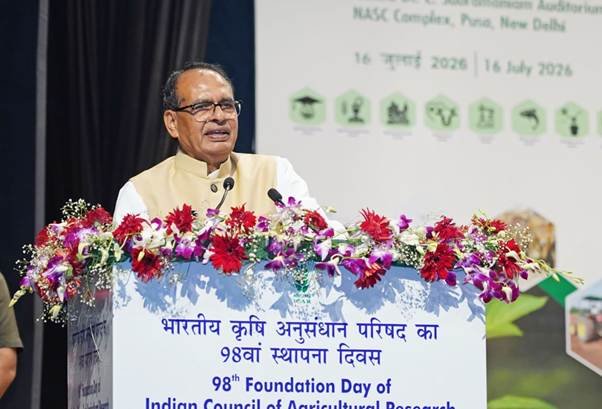
At ICAR’s 98th Foundation Day, Union Minister Shivraj Singh Chouhan outlines roadmap for climate-smart farming, innovation and Viksit Bharat 2047
Key Highlights
- ICAR developed 386 improved crop varieties across 44 crops during the past year.
- 94% of the new varieties are climate-resilient, while 29 are biofortified.
- 43 improved crop varieties, 17 advanced technologies and 14 publications released.
- 72 MoUs signed with 51 industry partners to accelerate technology transfer.
- 150 temporary daily-wage workers regularised during the Foundation Day event.
- Agricultural research contributed an estimated ₹55,000 crore to the economy, while increased production generated nearly ₹1.70 lakh crore in additional economic value.
- Over one crore farmers directly benefited from scientific technologies, with outreach extending to more than five crore farmers through media platforms.
ICAR Celebrates 98 Years of Agricultural Innovation
The Indian Council of Agricultural Research (ICAR) celebrated its 98th Foundation Day in New Delhi, highlighting nearly a century of scientific contributions that have transformed Indian agriculture while unveiling fresh initiatives aimed at building climate-resilient, technology-driven farming under the vision of Viksit Bharat 2047.
Addressing the event, Union Agriculture and Farmers’ Welfare Minister Shivraj Singh Chouhan described ICAR as the “trailblazer of India’s agricultural transformation,” emphasizing that scientific research remains the backbone of food security, farmer prosperity and sustainable agricultural growth.
386 Improved Crop Varieties Developed in One Year
Highlighting ICAR’s achievements during 2025-26, the Minister announced that the organisation developed 386 improved crop varieties across 44 different crops, with 94% designed to withstand climate-related stresses and 29 biofortified varieties aimed at improving nutritional security.
He stressed that future agricultural research must become increasingly demand-driven, focusing on climate resilience, self-reliance in pulses and oilseeds, commercialization of innovations and wider technology dissemination through the Krishi Vigyan Kendra (KVK) network.
“Farmers are the soul of agriculture, while scientists are its brain,” Shri Chouhan said while underlining the importance of stronger collaboration between research institutions and farming communities.
Major Agricultural Technologies Released
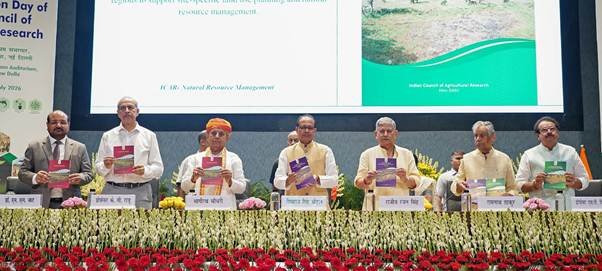
During the Foundation Day celebrations, ICAR released:
- 43 improved crop varieties
- 17 advanced agricultural technologies
- 14 scientific publications
Among the important innovations unveiled were:
- Climate-resilient and saline-tolerant rice varieties
- Export-oriented mango production technology
- India’s first indigenous African Swine Fever vaccine
- Digital Swine Disease Atlas
- Affordable cassava harvester for small farmers
The event also witnessed the signing of 72 Memoranda of Understanding (MoUs) with 51 industry partners to speed up commercialization and large-scale adoption of ICAR-developed technologies.
Research Delivering Economic Returns
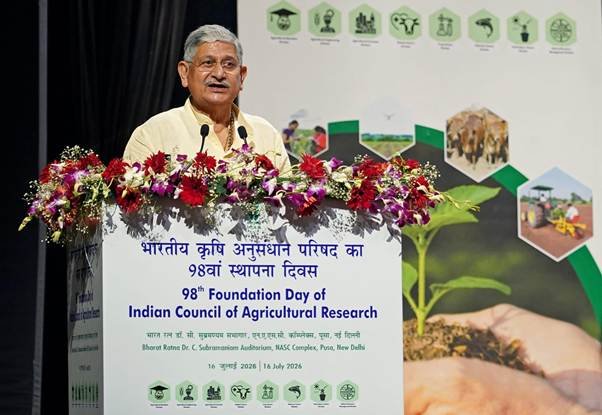
Presenting ICAR’s annual performance report, Dr. M.L. Jat, Secretary, Department of Agricultural Research and Education (DARE) and Director General, ICAR, said agricultural research continued to generate significant economic returns.
According to ICAR:
- Agricultural production growth generated nearly ₹1.70 lakh crore in additional economic value during the year.
- Agricultural research contributed an estimated ₹55,000 crore to the economy.
- Scientific technologies directly reached nearly one crore farmers.
- More than five crore farmers were reached through media and digital communication platforms.
- ICAR strengthened global cooperation through 18 international MoUs.
Focus on Sustainable Agriculture
Other Union Ministers participating in the event emphasized the growing importance of science-led agriculture.
Union Fisheries, Animal Husbandry and Dairying Minister Rajiv Ranjan Singh called for faster technology transfer through Krishi Vigyan Kendras, while Ministers of State Ram Nath Thakur, Bhagirath Choudhary, and Prof. S.P. Singh Baghel highlighted the importance of natural farming, climate resilience, improved livestock technologies, fisheries, micro-irrigation, nano-fertilizers and self-reliance in pulses and oilseeds.
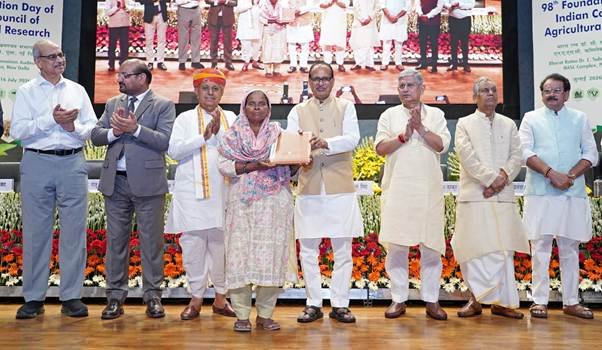
The programme also included the regularisation of 150 temporary daily-wage employees, marking an important administrative milestone for ICAR.
Hospitality, Food Processing and Agri-Business Impact
The latest research pipeline is expected to benefit multiple sectors beyond agriculture. Climate-resilient and biofortified crop varieties can improve the availability of quality raw materials for the food processing industry, while export-oriented technologies for crops such as mangoes support India’s growing processed food and fresh produce exports.
Advancements in livestock health, fisheries, disease-resistant crops and value-added agricultural technologies are also expected to strengthen supply chains serving hotels, restaurants, catering businesses and food manufacturers. Improved farm productivity and higher-quality produce could further enhance India’s competitiveness in global agri-food exports while supporting rural employment and agri-tourism initiatives.
With climate change increasingly influencing agricultural production, ICAR’s focus on resilient farming technologies is expected to play a critical role in ensuring stable food supplies for both domestic consumption and the hospitality sector while contributing to the country’s long-term food and nutritional security.