Global Dryland Congress 2026 Opens in New Delhi with 800+ Experts to Shape Future of Dryland Agriculture
ICAR and ICRISAT-led three-day Congress to focus on climate resilience, nutrition, markets, seed systems and inclusive farming New Delhi, September 9, 2026: More than 800 scientists, policymakers, farmer representatives and development partners from across Asia, Africa
ICAR and ICRISAT-led three-day Congress to focus on climate resilience, nutrition, markets, seed systems and inclusive farming
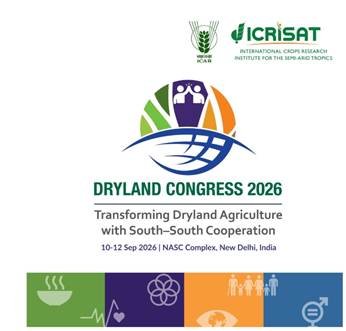
New Delhi, September 9, 2026: More than 800 scientists, policymakers, farmer representatives and development partners from across Asia, Africa and the Americas will gather in New Delhi for the Global Dryland Congress 2026, being held from September 10–12, 2026.
The three-day Congress, themed “Transforming Dryland Agriculture with South–South Cooperation,” is being jointly organised by the Indian Council of Agricultural Research (ICAR) and the International Crops Research Institute for the Semi-Arid Tropics (ICRISAT) at the National Agricultural Science Complex.
The event also marks 50 years of the ICAR–ICRISAT partnership and will bring together the global dryland agriculture community to discuss strategies for improving productivity, resilience and livelihoods in dryland regions.
Key Highlights
- Global Dryland Congress 2026 to be held in New Delhi from September 10–12.
- More than 800 global experts and stakeholders expected to participate.
- Theme: “Transforming Dryland Agriculture with South–South Cooperation.”
- Drylands cover approximately 45% of the world’s land surface and support more than 2 billion people.
- Six focus areas: breeding, climate resilience, nutrition and markets, farming systems, seed systems, and gender and youth inclusion.
- Congress marks 50 years of ICAR–ICRISAT partnership.
- Special sessions on South–South and Triangular Cooperation (SSTC) in agricultural research.
- Event will culminate in the Delhi Declaration on Dryland (3D).
- New partnerships, MoUs and awards for contributions to dryland science are also expected.
Why Dryland Agriculture Matters
Drylands account for nearly half of the world’s land surface and support more than two billion people, including large numbers of smallholder farmers.
These regions face growing challenges from climate variability, water scarcity, land degradation and changing agricultural markets. The Congress will therefore focus on developing agricultural approaches that can improve resilience while addressing food and nutrition security and rural livelihoods.
Discussions will span crop breeding and seed systems alongside farming systems, markets, nutrition and the participation of women and young people in agriculture.
India to Host Global Dialogue on Dryland Innovation
The Congress brings together agricultural research and policy communities from multiple continents, creating a platform for sharing technologies, scientific knowledge and farming practices suited to water- and resource-constrained environments.
The programme will feature keynote addresses, panel discussions, parallel sessions, lead presentations and poster exhibitions.
The final day will also commemorate the United Nations Day for South–South Cooperation, with dedicated sessions on strengthening South–South and Triangular Cooperation in agricultural research, organised in collaboration with CGIAR.
The proceedings are expected to conclude with the Delhi Declaration on Dryland (3D), alongside announcements of new partnerships and memoranda of understanding.
Union Agriculture and Farmers’ Welfare and Rural Development Minister Shivraj Singh Chouhan will address the Congress as Chief Guest. The event will also feature global agricultural research leaders, including representatives from ICAR, ICRISAT and CGIAR, as well as former ICAR and ICRISAT leaders and international dryland agriculture experts.
Impact on Hospitality, Food and Travel & Tourism
The Global Dryland Congress has relevance beyond agricultural research, particularly for the food, hospitality and tourism ecosystem.
Food Security and Hospitality Supply Chains
Dryland regions contribute significantly to the production of crops and livestock that feed local and regional populations. Innovations in climate-resilient crops, seed systems and farming practices can help strengthen the long-term resilience of food supply chains.
For hotels, restaurants and foodservice operators, greater agricultural resilience can translate into more stable access to regionally important ingredients.
Millets and Sustainable Cuisine
The Congress’s focus on dryland agriculture also reinforces the growing importance of millets and climate-resilient crops. These crops offer opportunities for hotels and restaurants to develop menus around millet-based, regional and sustainable Indian cuisine.
This creates a potential intersection between agricultural innovation and India’s evolving wellness and sustainable dining trends.
Agri-Tourism and Rural Experiences
Dryland farming communities and their agricultural traditions can also become part of rural and agri-tourism experiences. Farm visits, indigenous food experiences, traditional farming practices and local culinary products can provide new tourism narratives for semi-arid regions.
India as a Knowledge and Conference Destination
Hosting a global gathering of more than 800 agricultural experts also reinforces New Delhi’s role as a destination for international knowledge, research and policy conferences.
The event can generate demand across hotels, conference venues, restaurants, transport and other business-travel services during the three-day programme.
Industry Takeaway
The Global Dryland Congress 2026 places climate-resilient agriculture, food security and rural livelihoods at the centre of an international South–South dialogue. For the hospitality and tourism industry, its relevance lies in the growing connection between resilient food systems, millet and regional cuisine, sustainable sourcing, rural tourism and international business events.
As agriculture adapts to climate and water challenges, the innovations emerging from dryland regions could increasingly influence what reaches hotel and restaurant kitchens—and how destinations tell their food and rural stories.