India’s First Soil-Carbon Payments Reach Farmers in Punjab and Haryana
Over ₹2.9 Crore to Reach 2,550 Farmers Adopting Regenerative Practices Including Direct-Seeded Rice and Crop-Residue Management New Delhi, September 17, 2026: India has taken a significant step in linking regenerative agriculture with farmer income, with more
Over ₹2.9 Crore to Reach 2,550 Farmers Adopting Regenerative Practices Including Direct-Seeded Rice and Crop-Residue Management
New Delhi, September 17, 2026: India has taken a significant step in linking regenerative agriculture with farmer income, with more than 2,500 smallholder farmers in Punjab and Haryana set to receive digital payments generated through agricultural carbon credits.
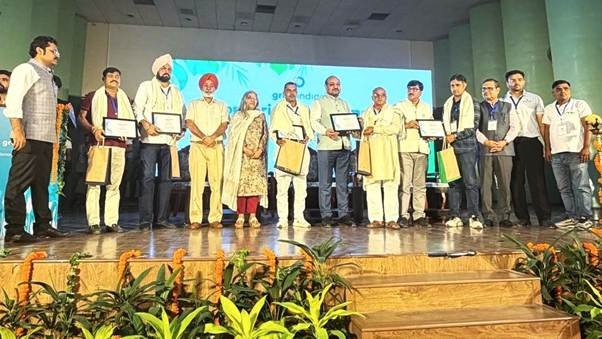
The first payments were released at an event at Punjab Agricultural University (PAU), Ludhiana), where Dr M. L. Jat, Secretary, Department of Agricultural Research and Education (DARE) and Director General, ICAR, initiated Direct Benefit Transfers to 2,550 farmers.
More than ₹2.9 crore is being disbursed under the initiative, marking a transition from India’s agricultural carbon-market framework to direct, farm-level financial benefits for participating farmers.
Key Highlights
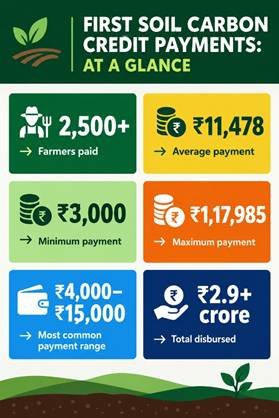
- 2,550 farmers from Punjab and Haryana are receiving the first soil-carbon payments.
- More than ₹2.9 crore is being disbursed.
- Farmers adopted Direct Seeded Rice (DSR), reduced tillage and crop-residue management.
- The practices were implemented between 2019 and 2022 and subsequently measured and independently verified.
- The programme covers more than 2 million acres and 100,000 farmers across seven states.
- The first carbon-credit issuance covered around 30,000 acres and more than 50,000 credits.
- Participating farmers received approximately ₹3,000–₹15,000, depending on their share of carbon credits.
- The programme estimates savings of 45 billion litres of water.
- More than 2 lakh tonnes of crop residue were kept out of fires, according to programme estimates.
- Farmers could opt for an assured upfront payment or 75% of net carbon revenue after credit sales.
- ICAR institutions have contributed to carbon measurement, soil sampling, modelling, field validation and remote-sensing processes.
From Regenerative Farming to Direct Farmer Payments
The payments are part of ‘Aadi’, a Grow Indigo farmer carbon programme launched in 2019 with technical guidance from ICAR.
Participating farmers adopted practices designed to improve soil health and reduce greenhouse-gas emissions, including Direct Seeded Rice, reduced tillage and improved crop-residue management.
The environmental outcomes generated through these practices were measured and independently verified before carbon credits were issued under the Verra VM0042 methodology.
The first issuance covered approximately 30,000 acres and more than 50,000 carbon credits, with participating farmers receiving payments ranging from around ₹3,000 to ₹15,000 based on their contribution to the carbon credits generated.
The payments were released digitally by Grow Indigo from its own funds before the credits were fully sold, allowing participating farmers to receive the financial benefit without waiting for the sale proceeds.
How Farmers Earn Through Carbon Credits
The initiative creates an economic link between agricultural practices and measurable environmental outcomes.
Farmers who adopted eligible practices generated carbon benefits through reduced emissions and increased soil carbon. These outcomes were measured, verified and converted into carbon credits.
Farmers were then paid according to their share of the credits generated from their fields.
They could choose between an assured upfront payment or 75% of the net carbon revenue after the credits were sold.
Farmers who joined the programme after 2022 are part of the next monitoring cycle and are expected to receive payments as their carbon credits are subsequently issued.
DSR and Residue Management Deliver Multiple Benefits
The programme links carbon payments with agricultural practices that can also address other challenges facing Punjab and Haryana.
Direct Seeded Rice (DSR) can reduce irrigation requirements compared with conventional rice transplantation, while improved crop-residue management can help reduce the practice of stubble burning.
According to programme estimates, enrolled fields between 2019 and 2022 saved approximately 45 billion litres of water and kept more than 2 lakh tonnes of crop residue out of fires, avoiding an estimated 1,000 tonnes of PM2.5 emissions.
These outcomes place carbon farming within a broader framework of water conservation, soil health, air-quality improvement and climate resilience.
ICAR’s Lab-to-Land Approach Supports Carbon Agriculture
ICAR institutions have contributed scientific and field expertise to the programme, including greenhouse-gas accounting, crop-simulation modelling, soil-sampling protocols, device validation, field-team training, satellite imagery and remote sensing.
The ICAR–Indian Agricultural Research Institute (IARI), New Delhi, has contributed to these processes, while Grow Indigo is also working with ICAR–Agricultural Technology Application Research Institute (ATARI), Zone 1, to promote regenerative agriculture.
The initiative brings together research institutions, agricultural universities, Krishi Vigyan Kendras and state-level institutions to support the wider adoption of practices such as minimum soil disturbance, residue retention, diversified cropping, improved soil biology and efficient water use.
Punjab Records Decline in Farm-Fire Incidents
The development comes against the backdrop of continuing efforts to reduce crop-residue burning in Punjab.
Government data cited in the release shows that Punjab recorded 5,114 farm-fire incidents during the 2025 paddy harvesting season, described as the lowest number since monitoring under the current framework began.
The figure represented a 93% reduction compared with 2021 and a 90% reduction compared with 2022.
The Ransinh Kalan model in Moga was also highlighted, with the village maintaining a 100% residue-burning-free status across 1,310 acres for six consecutive years.
India Links Regenerative Agriculture with Global Cooperation
The carbon-farming initiative also connects with India’s broader international cooperation on regenerative agriculture.
At the 16th BRICS Agriculture Ministers’ Meeting, held in Indore in June 2026 under India’s chairship, participating countries agreed to establish a BRICS Network of Centres of Excellence on Agroecology and Regenerative Agriculture for Climate Resilience and Productivity.
Initial coordination of the network is being undertaken by ICAR–Indian Institute of Farming System Research (IIFSR), Modipuram.
The BRICS New Delhi Declaration, adopted in September 2026, subsequently welcomed the strengthening of cooperation through the network.
Impact on Food, Hospitality and Travel & Tourism
The development has a wider relevance for the food and hospitality ecosystem, even though the immediate beneficiaries are agricultural producers.
Food Supply and Sourcing
Regenerative agriculture can influence the long-term resilience of food supply chains by focusing on soil health, water efficiency, crop-residue management and resource conservation.
For foodservice businesses, stronger agricultural resilience can potentially support more stable sourcing of locally produced ingredients over time.
Sustainable Hospitality
Hotels and restaurants increasingly incorporate local sourcing, sustainable procurement and farm-to-table narratives into their food programmes.
Carbon-linked agricultural initiatives can provide an additional dimension to these efforts by creating traceable connections between sustainable farming practices and the ingredients entering the food chain.
Culinary and Rural Tourism
Punjab and Haryana have strong agricultural identities and distinctive food cultures. Regenerative farming and farmer-led sustainability initiatives can potentially contribute to agritourism, culinary tourism and rural destination experiences, particularly where visitors can engage with local food production and traditional agricultural practices.
Climate-Resilient Tourism Supply Chains
Water availability, food production and climate resilience are increasingly relevant to tourism destinations. Agricultural programmes that improve resource efficiency can therefore have indirect importance for the resilience of the wider hospitality and tourism supply chain.
Industry Takeaway
The first soil-carbon payments represent a new link between measurable environmental outcomes and farmer income.
For India’s food and hospitality sectors, the development is significant because regenerative agriculture is moving beyond an environmental concept towards a system that can potentially connect farm practices, carbon markets, farmer earnings, resource conservation and food supply chains.
As carbon-credit systems and regenerative agriculture programmes expand, hotels, restaurants and food companies could increasingly encounter opportunities to connect their sustainability and sourcing strategies with farmers adopting verified climate-smart practices.