BRICS Tourism Ministers Adopt Jaipur Declaration to Strengthen Sustainable and Seamless Travel
Nine BRICS member states back cooperation on AI, responsible tourism, skilling, investment and stronger people-to-people connectivity Key Highlights BRICS Tourism Ministers adopted the 2026 Tourism Ministers’ Communiqué (Jaipur Declaration) by consensus in Jaipur. The declaration sets out a
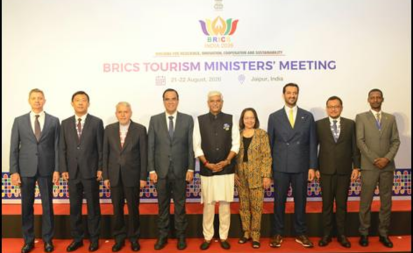
Nine BRICS member states back cooperation on AI, responsible tourism, skilling, investment and stronger people-to-people connectivity
Key Highlights
- BRICS Tourism Ministers adopted the 2026 Tourism Ministers’ Communiqué (Jaipur Declaration) by consensus in Jaipur.
- The declaration sets out a framework for stronger tourism cooperation among BRICS member states.
- Four priorities include AI and tourism, sustainability, skilling and seamless travel.
- Ministers backed cooperation in tourism investment, infrastructure, digital technologies, data sharing and destination management.
- India highlighted tourism’s role in creating opportunities for hotels, homestays, transport operators, guides, artisans, farmers and local communities.
The BRICS Tourism Ministers’ Meeting in Jaipur has adopted the BRICS Tourism Ministers’ Communiqué 2026, also known as the Jaipur Declaration, establishing a framework for deeper cooperation in tourism among member states.
The meeting, held under India’s BRICS Chairship, was chaired by Union Minister for Culture and Tourism Gajendra Singh Shekhawat and marked the culmination of India’s BRICS Tourism Track for 2026 under the theme “Building for Resilience, Innovation, Cooperation and Sustainability.”
Nine BRICS member states participated in the meeting, including Brazil, Iran, South Africa, the United Arab Emirates, China, Ethiopia, Indonesia, Russia and India.
Jaipur Declaration focuses on four tourism priorities
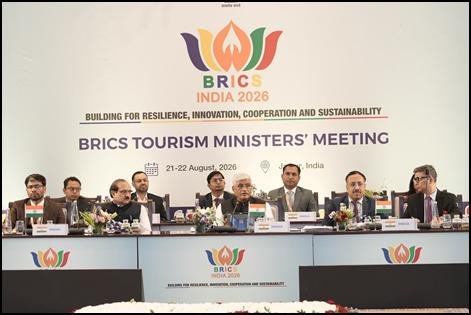
The declaration builds on the work of the BRICS Tourism Working Group and focuses on four key areas:
- Artificial Intelligence and Tourism
- Sustainability and Responsible Tourism
- Tourism Skilling and Capacity Building
- Tourism Exchanges and Seamless Travel Facilitation
The ministers recognised the potential of responsible, safe and human-centred AI and digital technologies to transform tourism.
The declaration supports cooperation in areas including tourism planning, destination management, visitor services, multilingual communication and travel facilitation.
Sustainable and community-led tourism gains focus
The ministers also placed emphasis on sustainable and community-centred tourism, including the protection of natural and cultural heritage.
The framework calls for greater cooperation on tourism investment and infrastructure, development of diverse tourism products, sharing of best practices, tourism data and statistics, and stronger people-to-people connectivity.
For destinations, the focus signals a move towards tourism models that combine economic growth with environmental responsibility and greater participation from local communities.
India highlights tourism’s role in inclusive growth
Addressing the meeting, Tourism Minister Gajendra Singh Shekhawat said tourism has an important role in India’s journey towards Viksit Bharat 2047.
He highlighted tourism’s ability to spread economic activity beyond major centres to towns, villages and remote regions.
The Minister also pointed to the wide range of businesses and communities supported by tourism, including hotels and homestays, taxi operators, guides, artisans, weavers, farmers and entrepreneurs.
According to the Minister, India’s approach is aimed at building a tourism ecosystem that is economically prosperous, environmentally responsible, technologically enabled and culturally authentic.
Hospitality sector stands to benefit from deeper BRICS cooperation
The Jaipur Declaration has direct relevance for the hospitality and travel industry.
Hotels and homestays: Stronger tourism exchanges among BRICS countries could support international visitor flows and create opportunities for accommodation businesses in both established and emerging destinations.
Food and beverage: Greater cultural exchange and international travel can increase demand for regional cuisine, destination dining and authentic local food experiences.
Travel operators: Seamless travel facilitation and stronger connectivity could help operators develop new inbound packages and multi-destination itineraries targeting BRICS markets.
Technology: Cooperation on AI, multilingual communication, visitor services and destination management could accelerate the adoption of digital tools across hotels, attractions and tourism businesses.
Skills and employment: The emphasis on continuous skilling and upskilling, along with industry-academia partnerships, could help address evolving workforce requirements across hospitality and tourism.
Community tourism: Greater emphasis on community-centred tourism could create opportunities for homestays, local guides, artisans, farmers and small tourism entrepreneurs to participate more directly in visitor spending.
Tourism investment and infrastructure also on the agenda
The declaration’s emphasis on tourism investment and infrastructure could encourage greater cooperation between governments and industry stakeholders.
Combined with the focus on developing diverse tourism products, this could support investment in destinations built around culture, heritage, nature, wellness, adventure and community experiences.
India holds bilateral tourism discussions
On the sidelines of the ministerial meeting, India held bilateral discussions with Brazil, Iran, South Africa and the United Arab Emirates to take forward tourism cooperation.
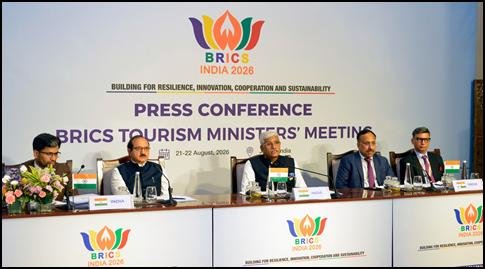
A press conference was also held to present the outcomes of India’s BRICS Tourism Track and the adoption of the Jaipur Declaration.
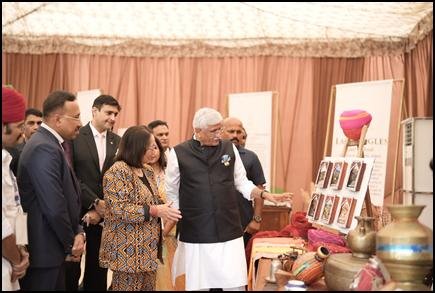
Curated tourism experiences showcasing traditional arts, crafts and community-based tourism were also organised alongside the ministerial programme, reinforcing the focus on India’s cultural and community-led tourism offerings.
What the Jaipur Declaration means for travel and tourism
The Jaipur Declaration moves BRICS tourism cooperation beyond promotion towards a broader framework covering technology, sustainability, investment, workforce development and travel facilitation.
For India’s hospitality sector, the biggest opportunities could come from stronger international visitor exchanges, improved digital tourism services, skilled manpower and greater visibility for local destinations and experiences.
For travel and tourism businesses, the declaration also provides a platform to build stronger links with BRICS markets while positioning community-based, culturally authentic and sustainable tourism as key components of future growth.
Bottom line
The adoption of the Jaipur Declaration gives BRICS tourism cooperation a common framework centred on resilience, innovation, sustainability and collaboration. For India’s tourism and hospitality industry, its focus on seamless travel, AI, investment, skilling and community participation could support a more connected and experience-driven tourism ecosystem.