Agriculture Ministry Reviews Monsoon, Fertiliser Supply and El Niño Outlook; Calls for Close Monitoring of 270 Rainfall-Sensitive Districts
Union Agriculture Minister Shivraj Singh Chouhan directs States to ensure timely fertiliser availability, strengthen Kharif crop monitoring and prepare contingency plans amid below-normal rainfall Key Highlights Union Agriculture Minister Shivraj Singh Chouhan reviewed Kharif sowing, monsoon progress,
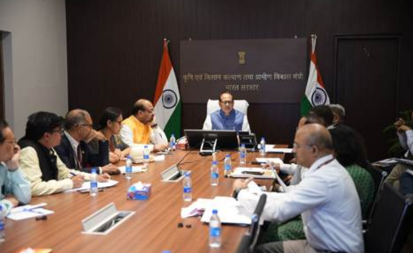
Union Agriculture Minister Shivraj Singh Chouhan directs States to ensure timely fertiliser availability, strengthen Kharif crop monitoring and prepare contingency plans amid below-normal rainfall
Key Highlights
- Union Agriculture Minister Shivraj Singh Chouhan reviewed Kharif sowing, monsoon progress, fertiliser and seed availability, reservoir levels and the El Niño outlook.
- South-West Monsoon covered the entire country by July 9, 2026, creating favourable conditions for Kharif sowing.
- Total Kharif sowing reached 658.19 lakh hectares as of July 17, 2026.
- Agriculture Ministry is closely monitoring 270 rainfall-sensitive districts across India.
- India recorded 23% below-normal rainfall between June 1 and July 15, 2026.
- Weekly review meetings to be held for pulses, oilseeds and cotton missions with State Governments.
- Minister directed officials to ensure timely fertiliser distribution, particularly urea, and maintain adequate seed availability.
- Krishi Vigyan Kendras (KVKs) will help monitor ground-level availability of agricultural inputs.
Agriculture Ministry Intensifies Kharif Monitoring Amid Monsoon Deficit and El Niño Concerns
The Ministry of Agriculture and Farmers’ Welfare has stepped up monitoring of the ongoing Kharif season following a high-level review chaired by Union Agriculture and Farmers’ Welfare Minister Shri Shivraj Singh Chouhan.
The meeting assessed the progress of Kharif sowing, the status of the South-West Monsoon, possible El Niño conditions, rainfall-deficient districts, fertiliser and seed availability, and water storage in reservoirs.
The Minister instructed officials to maintain close coordination with State Governments, particularly in districts experiencing rainfall deficits, while ensuring quick implementation of contingency measures wherever required.
South-West Monsoon Covers Entire Country
Officials informed the Minister that the South-West Monsoon reached all parts of India by July 9, 2026, including the remaining areas of Rajasthan, Haryana and Punjab.
Although the monsoon covered the country one day later than the usual July 8 timeline, the nationwide spread has created favourable conditions for Kharif sowing across most agricultural regions.
As of July 17, farmers had sown 658.19 lakh hectares under Kharif crops. While the total sown area remains lower than the corresponding period last year, the Government noted encouraging progress in paddy, pulses and several other crops across multiple States.
To maintain momentum, Shri Chouhan directed that weekly review meetings be conducted under the Pulses, Oilseeds and Cotton Missions, allowing State Governments to address field-level challenges quickly.
23% Rainfall Deficit Keeps 270 Districts Under Watch
The Ministry reviewed rainfall distribution using weather forecasts from the India Meteorological Department (IMD) along with crop health indicators such as the Normalised Difference Vegetation Index (NDVI).
Between June 1 and July 15, 2026, India received 227 mm of rainfall, compared to the normal 294.2 mm, representing a 23% rainfall deficit.
Regional rainfall deficiencies included:
- East & Northeast India: 36% below normal
- Southern Peninsular India: 26% below normal
- Northwest India: 19% below normal
- Central India: 13% below normal
The Ministry is currently monitoring 270 rainfall-sensitive districts and coordinating contingency agricultural measures with State Governments wherever necessary.
Government Reviews Fertiliser and Seed Availability
The review also focused on the availability of fertilisers—particularly urea—and quality seeds for the Kharif season.
Officials informed the Minister that adequate stocks have been arranged, with continuous coordination underway between the Centre and State Governments to monitor supplies.
Shri Chouhan directed officials to verify the ground situation through Krishi Vigyan Kendras (KVKs) and State agencies, ensuring farmers receive fertilisers according to demand and that any bottlenecks in the distribution system are resolved immediately.
The Minister also instructed both departments under the Agriculture Ministry to continue scientific monitoring of crop conditions, promote weather-based farm advisories and ensure effective implementation of agricultural schemes throughout the Kharif season.
Hospitality, Food & Tourism Impact
The Agriculture Ministry’s review carries significant implications for India’s hospitality, foodservice and tourism sectors, where agricultural output directly influences food availability and pricing.
- Hotels, restaurants and catering companies rely on stable production of rice, pulses, vegetables and edible oils, making monsoon performance a key factor in procurement planning.
- Continuous monitoring of fertiliser and seed supplies helps reduce the risk of production disruptions that could affect food costs for hospitality businesses.
- Adequate agricultural support during the Kharif season contributes to more stable food supply chains, benefiting restaurants, cloud kitchens, institutional caterers and hotel operators.
- Rainfall conditions also influence rural tourism, agritourism and plantation-based experiences, particularly in destinations where agriculture forms part of the visitor experience.
- The Government’s emphasis on scientific monitoring and contingency planning provides confidence that measures are in place to mitigate weather-related disruptions to agricultural production.
Hospitality Outlook
While the current 23% rainfall deficit warrants close monitoring, the nationwide advancement of the South-West Monsoon and the Government’s proactive approach to fertiliser availability, crop monitoring and contingency planning are positive signals for the hospitality industry. Stable agricultural production remains essential for maintaining food quality, managing procurement costs and supporting India’s growing culinary, rural and experiential tourism sectors.