Guest Trust in the Digital Era: Why India’s DPDP Act Must Reshape Hotel Data Strategies
Authored article by Dr. Parikshit Sharma, Dean, Faculty of Tourism & Hospitality, C. V. Raman Global University, Bhubaneswar, Odisha Authored article by Priya Sharma, HoD, Institute of Hotel Management, Raipur, Chhattisgarh We have watched our industry evolve through several
Authored article by Dr. Parikshit Sharma, Dean, Faculty of Tourism & Hospitality, C. V. Raman Global University, Bhubaneswar, Odisha
Authored article by Priya Sharma, HoD, Institute of Hotel Management, Raipur, Chhattisgarh
We have watched our industry evolve through several defining shifts. We remember, during our training at Taj Residency Indore, and later the profession in Raas Devigarh Udaipur, Sayaji Hotels Indore and the academics, we searched through paper ledgers, and later through integrated Property Management Systems (PMS); which in the past decade, shifted to online booking engines, and adopted AI-driven guest personalization. Yet, amidst these hospitality & tourism dynamics, one fundamental truth has remained unchanged: “hospitality is built on trust”.
Today, with the ever evolving digital landscape, that trust faces a new challenge. In an era where a hotel guest hands over credit card details, ID proofs, passport scans, dietary preferences, and real-time location data before even receiving a room key, the guest data security is no longer an invisible IT function. It has become a core element of guest service.
To this, strengthening our digital landscapes, the government has brought into force the Digital Personal Data Protection (DPDP) Act, and privacy in hospitality has officially moved from a “best practice” to a stringent legal mandate. For hoteliers across India, understanding this shift, and taking immediate action, is vital to protecting guest trust and safeguarding operations against severe financial risks.
Now, a question comes to our mind: Why are the Hotels a Target for Data Breach?
The answer lies in the sheer volume and diversity of the personal information we process daily.
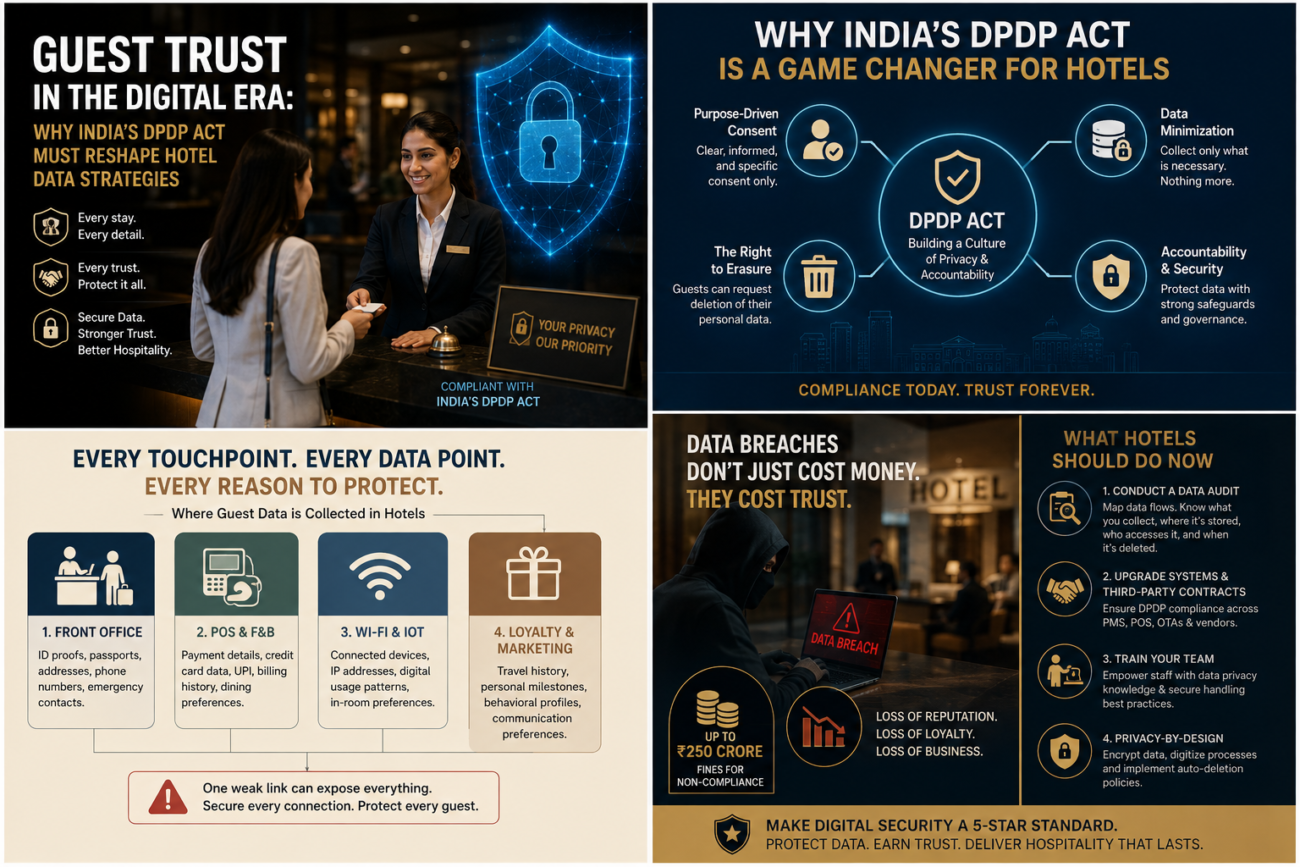
Every touchpoint across a guest’s journey in and out of the hotel, creates a digital footprint. You must be thinking where are these? The basic touchpoints are:
1. Front Office: where we gather from our guests their ID cards, passports, home addresses, phone numbers, and emergency contacts.
2. Point-of-Sale (POS) & F&B: supporting the financial transactions through credit card credentials, UPI, payment history, and dining preferences.
3. Guest Wi-Fi & Smart Room IoT: where their stay becomes comfortable through the connected devices, IP addresses, and digital usage patterns.
4. Loyalty Programs & Marketing: Travel histories, personal milestones, and behavioural profiles.
In many properties, this data flows across interconnected third-party systems, such as online travel agencies (OTAs), channel managers, payment gateways, and guest-messaging platforms. If even one link in this chain lacks for robust governance, the entire property becomes vulnerable to cyber threats and compliance failures.
What the DPDP Act Demands from Hoteliers?
The Act establishes clear boundaries for how businesses handle personal data. As “Data Fiduciaries,” hotel owners, operators, and management groups must align their practices with core principles that directly impact daily operations:
1. Purpose-Driven Consent: Hotels can no longer collect data under vague, blanket opt-ins. Guests must be informed, through clear, accessible language, exactly why their data is being collected and how it will be used. Using a guest’s contact number for promotional WhatsApp campaigns without explicit consent is now a violation.
2. Data Minimization: Properties must collect only the data necessary to fulfill a specific service. Keeping physical photocopies of IDs in unsecured over the reception counters or in front-desk binders, and storing sensitive guest profiles indefinitely without a defined retention policy is a significant risk under the law.
3. The Right to Erasure: Guests now have the right to request the deletion of their personal data once their stay is complete and statutory obligations (such as local law enforcement reporting) are satisfied.
Are the Hotels at the helm of Financial Penalties and Reputational Risks?
Of course:
The DPDP Act introduces significant consequences for non-compliance. Financial penalties for failure to implement reasonable security safeguards to prevent data breaches can reach up to ₹250 Crore. Even smaller operational lapses, such as failing to notify the Data Protection Board and affected individuals in the event of a breach, carry penalties scaling into tens or hundreds of crores.
For a hotel, however, the financial penalty is only half the crisis.
In hospitality, reputation is everything. A single publicized breach or privacy violation can dismantle decades of brand equity, turn away corporate bookers, destroy loyalty program participation, and permanently erode market standing. In 2026 and beyond, guest trust is a key financial asset, and data security will become its shield.
So, what should the hotels do?
Transitioning to full compliance does not require halting operations; it requires embedding Data Hygiene into your property’s operating culture. This demands focus on:
1. Conduct a Comprehensive Data Audit: Map every data flow within your property. Identify where guest data enters (front desk, website, OTAs), where it is stored (PMS, cloud servers, physical files), who has access to it, and when it is discarded.
2. Upgrade Systems and Third-Party Contracts: Ensure your PMS, POS, and CRM vendors are fully compliant with the DPDP Act. Demand clear Data Processing Agreements (DPAs) with third-party vendors to guarantee they meet the same security standards your property maintains.
3. Train Front-Line Staff: Cyber hygiene begins with the workforce. Front-desk agents, reservation desks, and marketing teams must be trained on consent protocols, secure document handling, and recognizing social engineering or phishing attempts.
4. Implement Privacy-by-Design: Standardize your operations to protect data automatically. Encrypt guest databases, transition from paper-based guest registration cards to secure digital check-ins, and establish auto-deletion schedules for legacy data.
Make and Promote your Digital Security as a 5-Star Standard:
The DPDP Act should not be viewed as a regulatory burden. Instead, it offers Indian hospitality an opportunity to raise its operating standards. Just as we invest in fire safety, physical security, and hygiene audits to ensure guest safety, we must now treat data privacy with equal rigor. By treating guest data with care and transparency, we build deeper loyalty, strengthen brand integrity, and ensure our properties remain secure, competitive, and trusted in a digital world.
If you wish to gain more insights about the how DPDP Act impacts the hospitality industry, order a copy now; Data, Privacy and Hospitality: A Hotelier’s Guide to India’s Digital Personal Data Protection Act 2023.