Thomas Cook India launches India Forex Report 2026, Unveiling key shifts in how Indians buy, carry and spend forex
· Emerging India reshapes forex demand, with Tier 2 and Tier 3 contributing 53% · Destination-specific currencies gain prominence beyond the US Dollar · Younger consumers accelerate digital forex adoption, with 25% now transacting digitally · Forex payment
· Emerging India reshapes forex demand, with Tier 2 and Tier 3 contributing 53%
· Destination-specific currencies gain prominence beyond the US Dollar
· Younger consumers accelerate digital forex adoption, with 25% now transacting digitally
· Forex payment behaviour shifts towards cards and digital experiences
· Study abroad demand expands beyond traditional corridors
· Corporate travellers show strong preference for forex cards, accounting for 84% of usage
Mumbai, August 12, 2026: Thomas Cook (India) Limited, India’s leading omnichannel foreign exchange services provider, has launched its India Forex Report 2026, offering insights into how Indian consumers are purchasing, carrying and spending foreign exchange across leisure travel, overseas education and corporate travel.
Based on Thomas Cook India’s forex transaction data for April 2025 to March 2026, the report captures emerging shifts across consumer demographics, travel corridors, purchase journeys, payment preferences and overseas spending. The findings point to an increasingly diversified Indian forex market, shaped by rising demand from emerging cities, younger digital-first consumers, evolving travel planning cycles and growing preference for secure and convenient payment solutions.
India Forex Report 2026 key observations:
India’s Forex Demand Is Becoming More Diversified
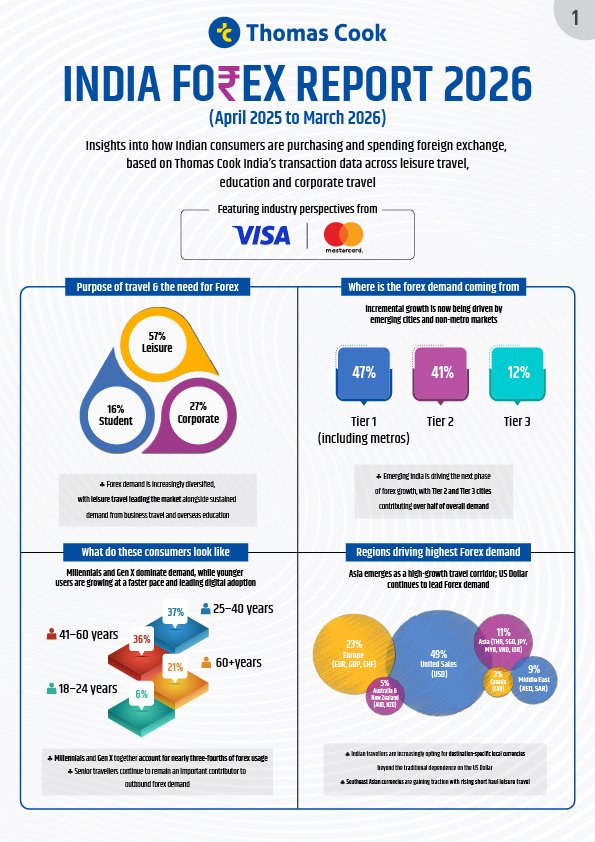
· Leisure travel remains the largest driver of forex demand, accounting for 57%, followed by corporate travel at 27% and overseas education at 16%, highlighting the increasingly diversified nature of India’s forex requirements.
· Emerging India is reshaping forex demand: The geographic base of forex demand is also expanding. Tier 1 cities, including metros, account for 47% of demand, while Tier 2 cities contribute 41% and Tier 3 contribute 12%. With Tier 2 and Tier 3 cities together contributing 53%, emerging India is driving the next phase of forex growth, reflecting rising outbound travel aspirations, overseas education and global mobility beyond traditional metropolitan centres.
· Millennials and Gen X dominate forex demand, while younger consumers lead digital adoption: Consumers aged 25–40 years (37%) and 41–60 years (36%) together account for nearly three-fourths of Thomas Cook India’s forex usage, underscoring their continued importance to the outbound travel market. At the same time, younger travellers aged 18–24 years (6%) are emerging as the fastest adopters of digital-first forex channels across the Thomas Cook India app, website, WhatsApp and quick commerce platforms. Senior travellers (21%) also continue to remain a significant contributor to outbound forex demand.
Destination-Specific Currencies Gain Ground
· Destination-specific currencies are gaining traction alongside the US Dollar: While the US Dollar continues to dominate forex demand with a 49% share, Indian travellers are increasingly purchasing destination-specific currencies, with Europe-linked currencies accounting for 23% of demand, followed by Asia at 11%, the Middle East at 9%, Australia & New Zealand at 5% and Canada at 3%. Increasing demand for currencies such as the Thai Baht, UAE Dirham, Singapore Dollar, Malaysian Ringgit and
Vietnamese Dong points to a gradual shift beyond traditional dependence on the US Dollar. Southeast Asian currencies are also gaining traction as short-haul leisure travel to the region grows.
Digital-First Forex Journeys Are Gaining Momentum
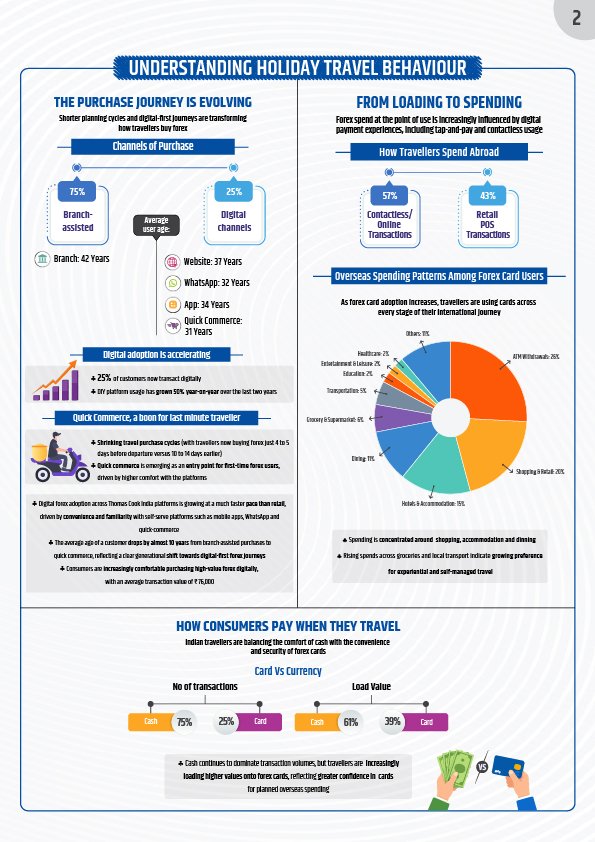
· Digital forex adoption is accelerating across younger consumers: While branch-assisted transactions account for 75% of forex purchases, 25% of customers now transact digitally across platforms including the website, app, WhatsApp and quick commerce.
· DIY platform usage has grown 50% year-on-year over the last two years, reflecting growing consumer comfort with self-serve forex journeys. The digital customer is also significantly younger, with the average age standing at 37 years on the Website, 34 years on the App, 32 years on WhatsApp and 31 years on Quick Commerce, compared with 42 years for branch-assisted transactions.
· Shorter planning cycles are reshaping the forex purchase journey. Indian travellers are increasingly purchasing forex closer to their departure dates, with buying cycles reducing from 10–14 days to just 4–7 days before travel. This behavioural shift is fuelling demand for instant fulfilment and quick-commerce-enabled forex delivery, particularly among younger and first-time forex users.
· Consumers are also increasingly comfortable with high-value digital forex transactions, with the average digital transaction value standing at ₹76,000.
From Cash to Cards: A Hybrid Consumer Emerges
· While cash remains an important part of the overseas payment journey, travellers are increasingly using forex cards for planned spending.
· Among holiday travellers, cash accounts for 75% of transactions, while cards account for 25%. However, when measured by load value, the share of cards rises to 39%, compared with 61% for cash. The higher value share of cards indicates growing confidence in forex cards for planned overseas spending.
· The point-of-use experience is also becoming increasingly digital. Contactless card (Tap & Pay) and online transactions account for 57% of forex card usage, while merchant and retail POS transactions contribute 42%.
· ATM withdrawals account for 26% of overseas spending, followed by shopping and retail at 20%
· Across overseas spending, ATM withdrawals account for 26%, followed by shopping and retail at 20%, hotels and accommodation at 15%, dining at 11%, grocery and supermarkets at 6% and transportation at 5%. The spending mix indicates that forex cards are increasingly being used across everyday expenses throughout the international travel journey.
India’s Study Abroad Market Is Expanding Beyond Traditional Corridors
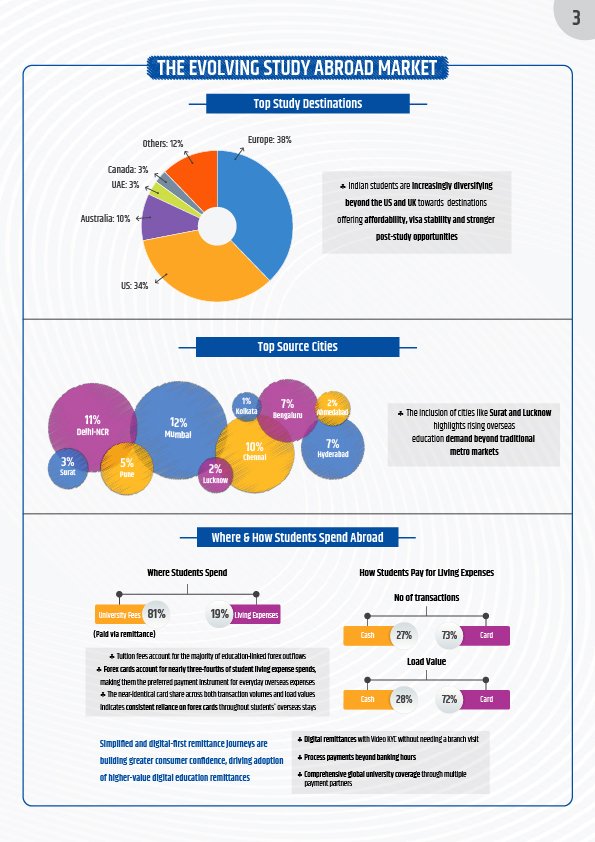
· India’s study abroad market continues to diversify: Indian students are increasingly exploring a wider range of international education destinations, with Europe accounting for 38% of study abroad demand, followed by the United States (34%), Australia (10%), Canada (3%), UAE (3%) and other destinations (12%). The trend reflects students’ growing preference for markets offering affordability, visa stability and stronger post-study opportunities.
· The source markets for overseas education are also widening. Mumbai contributes 12%, followed by Delhi-NCR at 11%, Chennai at 10%, Hyderabad and Bengaluru at 7% each. Demand is also emerging from cities including Pune, Surat and Lucknow, highlighting the growing overseas education aspirations beyond traditional metropolitan markets.
· University fees remain the dominant education-linked forex outflow, accounting for 81%, while living expenses contribute 19%.
· For living expenses, forex cards account for 73% of transactions and 72% of load value, compared with 27% and 28% respectively for cash. The near-identical card share across transaction volumes and load value indicates consistent reliance on forex cards for everyday expenses during students’ overseas stays.
· Digital-first remittance journeys are also supporting greater consumer confidence in education payments, with Video KYC enabling digital remittances without a branch visit, payments being processed beyond traditional banking hours, and multiple payment partners supporting global university coverage.
Corporate Travel Reflects India’s Growing Global Business Mobility
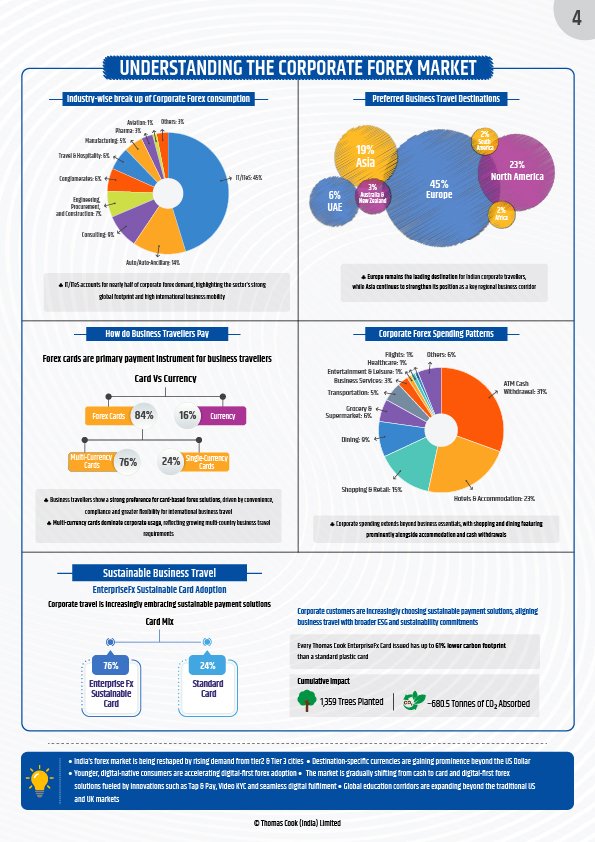
· Corporate forex demand is led by globally mobile sectors, with IT/ITeS accounting for 45% of forex consumption, followed by Auto/Auto-Ancillary at 14%, Consulting at 9% and Engineering, Procurement & Construction at 7%.
· Europe remains the leading corporate travel destination at 45%, followed by North America (US, Canada and Mexico) at 23% and Asia at 19%. Together, these three regions account for 87% of corporate international travel, with Asia continuing to strengthen as a key regional business corridor.
· Business travellers show a strong preference for card-based forex solutions. Forex cards account for 84% of corporate forex usage, compared with 16% for cash. Within card usage, multi-currency cards account for 76%, compared with 24% for single-currency cards, reflecting the growing need for flexible payment solutions across multiple destinations and currencies.
· Corporate spending extends beyond business essentials. ATM cash withdrawals account for 31% of spending, followed by hotels and accommodation at 23%, shopping and retail at 15%, dining at 9%, grocery and supermarkets at 6% and transportation at 5%.
· Sustainability is also emerging as part of corporate payment choices, with EnterpriseFx sustainable cards accounting for 76% of corporate card issuance. Every Thomas Cook EnterpriseFx Card issued has up to a 61% lower carbon footprint than a standard card. To date, the initiative has contributed to the planting of 1,359 trees and the absorption of approximately 680.5 tonnes of CO₂.

Mr. Deepesh Varma, Chief Business Officer – Foreign Exchange, Thomas Cook (India) Limited, said, “We are pleased to launch the India Forex Report 2026, which offers a unique perspective on how India’s forex consumer is evolving, based on Thomas Cook India’s transaction data across leisure, study abroad and corporate travel. The findings highlight a significant shift in consumer behaviour – from the rapid rise of digital-first and self-serve forex journeys to growing participation from Tier 2 and Tier 3 markets and increasing preference for destination-specific currencies. At Thomas Cook India, our sustained focus on innovation, omnichannel access and customer convenience has enabled us to stay ahead of these changing market dynamics. We are also seeing strong momentum across App-led transactions, WhatsApp journeys and quick-commerce-enabled forex fulfilment, particularly among younger travellers, alongside continued overseas education demand and growing reliance on card-based and multi-currency solutions among corporate travellers. As India’s outbound travel and global mobility story continues to expand, we intend to publish this report regularly to provide industry stakeholders with meaningful, data-led insights into the future of India’s forex market.”
Sridhar Keppurengan, Head of Cross-Border Payments, India and South Asia, Visa, said, “India’s outbound travel story is becoming more digital, more experience-led and increasingly diversified beyond traditional corridors. At Visa, we are seeing similar shifts in how Indian consumers plan and pay for international travel, with growing preference for secure, cash-light solutions, wider acceptance, local-currency convenience and greater control over spends. This behaviour is being shaped by rising travel aspirations from emerging cities, shorter planning cycles, stronger comfort with app-led and self-serve journeys, and the need for seamless payments across hotels, dining, shopping, education and everyday overseas experiences. As Indian travellers explore newer destinations and spend more meaningfully on global experiences, Visa remains focused on enabling cross-border payments that are secure, seamless, transparent and trusted, and be the best way to pay and be paid across the globe.”
Amarjit Walia, Senior Vice President, Account Management, South Asia at Mastercard, said, “The India Forex Report 2026 highlights the rise of a more digitally confident and globally connected Indian traveller, with growth increasingly driven by consumers from beyond the country’s metro cities. Whether travelling for leisure, business, education, or unique experiences, Indians today expect payment experiences that are quick, seamless, rewarding, and, most importantly, reassuring. The growing adoption of digital forex and card-based solutions clearly reflects a broader preference for greater control, convenience, and confidence in managing international spending. At Mastercard, we are committed to powering these cross-border journeys through our global acceptance network, advanced security capabilities, and innovative payment solutions that help cardholders engage with the world with greater ease and peace of mind.”