Noida International Airport weaves India’s rich artistry to welcome passengers
National, 26 May 2026: Noida International Airport (NIA) presents significant artworks by Padma Shri awardee Paresh Maity, seamlessly weaving India and Uttar Pradesh’s rich cultural heritage into its state-of-the-art infrastructure. It perfectly aligns with the architectural

National, 26 May 2026: Noida International Airport (NIA) presents significant artworks by Padma Shri awardee Paresh Maity, seamlessly weaving India and Uttar Pradesh’s rich cultural heritage into its state-of-the-art infrastructure. It perfectly aligns with the architectural experience and seamless flow design philosophy at NIA drawing from the legacy of Western UP, including use of red granite mirroring the monuments, steps to reflect ghats of Banaras, and aangan (open courtyard) inspired by the region’s havelis.
The thoughtful, passenger-centric terminal design aims to make the airport journey relaxed. Key highlights include a serene courtyard space after security, generous roof heights for a sense of openness, and curated art installations that create a tranquil environment. These elements, combined with natural light and intuitive wayfinding, deliver a warm and welcoming travel experience.
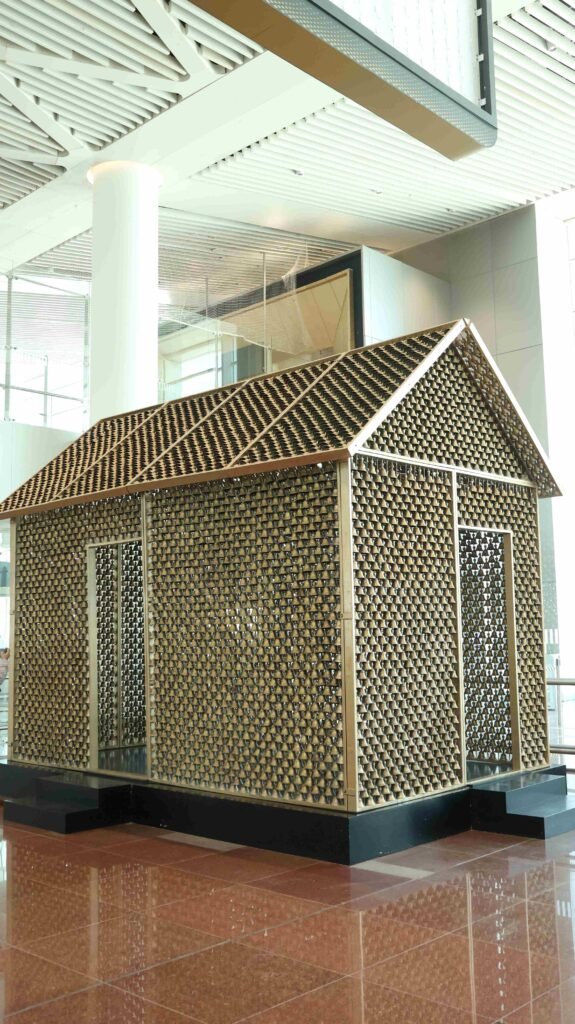
At the centre of NIA’s artistic integration is Paresh Maity’s experiential installation, ‘Mystic Abode’, an installation of more than 8000 brass bells. The contemporary world phenomenon, comprising environmental and social quandaries, has led people to seek peace amidst the chaos of everyday existence. The installation, Mystic Abode, reflects a desire to be in a transformative space where one takes a pause and reflects within, tapping into our inner senses of vision, tactician, and audition. The installation allows the viewers to experience a sense of calm and inner peace found rarely in the commotion of city life.
The reverberant acoustic quality of bells signifies achieving immense spirituality that creates an environment of peace and positive energy in the worship spaces in Indian homes as well as temples. Originating from this line of thought, Maity created an abode with these brass bells, giving rise to a space of transformation, of finding peace and spirituality within oneself. The installation radiates a message of positivity and the need to find solace in the chaos.
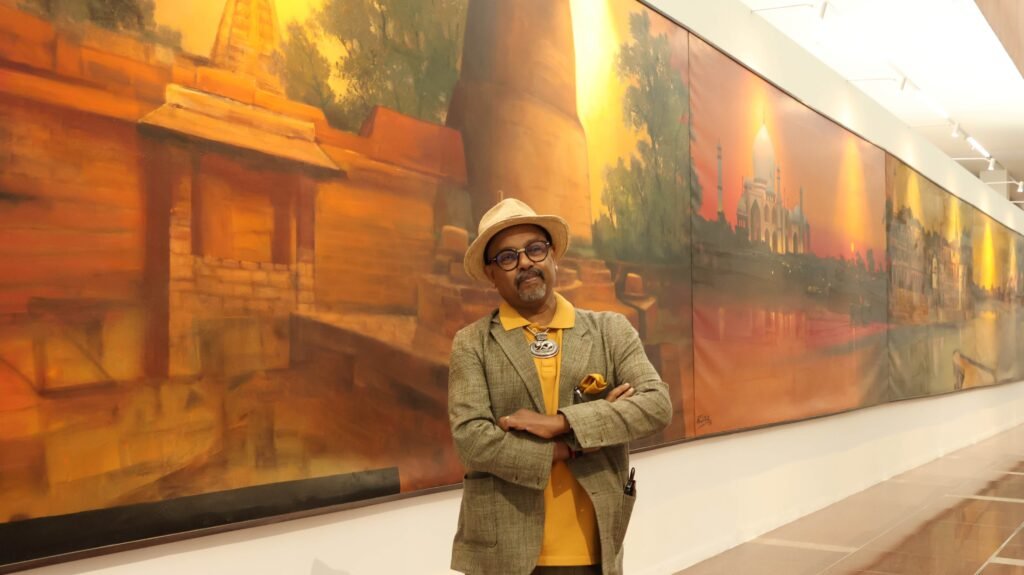
Complementing this is Mr. Maity’s monumental oil on canvas, ‘Awakening’ (Jagriti), a vibrant visual narrative showcasing iconic cultural and spiritual landmarks of India. Paresh Maity’s Jagriti is imbued with the spiritual energy of India, grounded in the principle of sadanga or the six limbs of art, which form the basis of aesthetics in Indian philosophy. This colossal painting unfolds across six panels, each connected by the thread of sacred water bodies – Ganga, Yamuna, Saraswati, and the Saryu River – and by the historic places that flourish along their banks.
The first panel depicts Varanasi, also known as Kashi, one of the oldest and most historically significant places in the world. The panel exudes tranquillity and peace, imbued with the element of devotion that invites the viewer to experience the holiness of the city. A spiritually inclined aesthetic with unique energy comes forth amidst the serene ghats lined with temples.
The second panel turns to the Sanchi Stupa of Sarnath, where the foundation of Buddhism was laid. Here, Buddha delivered his first sermon after enlightenment, imparting the principles of simplicity and detachment that lead to ultimate salvation, or moksha. Maity renders this devotional dynamism in his distinctive visual language.
The third panel captures a serene landscape of the symbol of love, the Taj Mahal in Agra, one of the seven wonders of the world. Nestled amidst the banks of the river Yamuna, it stands strong as an architectural marvel. The scenic beauty of the Taj is further enhanced by the sunrise where the monument glows in all its glory.
The fourth panel is based on Mathura and Vrindavan, depicting the Kusum Sarovar, a sacred water reservoir situated on the holy Govardhan Hill, located between Mathura and Vrindavan. The birthplace of lord Krishna, the holy site emerges as an idyllic landscape reflected gently upon the water. The play of light captures the region’s calm, spiritual atmosphere.
The fifth panel depicts Ayodhya, where lord Rama was born. Entrenched in historical importance, it is situated along the banks of the river Saryu. The grandeur and natural splendour of the city captured by Maity symbolizes India’s cultural legacy, interwoven with mythology, spirituality, and history.
The last panel captures the vivacious energy of the biggest spiritual gathering in the world, the Mahakumbh. Happening every twelve years, this massive Hindu pilgrimage leads to spiritual liberation and draws people from all over the world. This panel radiates the vast spiritual and devotional energy that signifies the vigour of Mahakumbh.
Across all six panels, a unifying element prevails: the light of early morning. The sunrise signifies both the dawning of a new day and the deeper spiritual awakening that runs through the entire work. Jagriti (Sanskrit translation of awakening) is an ode to India’s rich heritage, aesthetics, natural beauty, architecture, art, spirituality, and history.
Paresh Maity is one of India’s most celebrated contemporary artists, with a career spanning nearly five decades and 90 solo exhibitions across India and abroad. His works are part of leading public and private collections, including the Rashtrapati Bhawan, the British Museum, the Rubin Museum of Art in New York, the National Gallery of Modern Art in New Delhi, and the Kiran Nadar Museum of Art. He is also known for landmark public art projects, including one of the world’s longest murals at the International Terminal of Indira Gandhi International Airport in New Delhi.
Noida International Airport (NIA) is designed to seamlessly blend Swiss efficiency with Indian art and hospitality, creating a unique and memorable experience for passengers.
About Noida International Airport
Noida International Airport (IATA code – DXN) will connect the greater Delhi area and Western Uttar Pradesh with other cities in India and the world. This world-class airport will combine Swiss efficiency and Indian hospitality to offer rich experiences and comprehensive commercial attractions and services to its passengers. NIA is committed to an ambitious net-zero emissions goal supported by sustainable design and operations principles.
Yamuna International Airport Private Limited (YIAPL) was established for the development, construction and operation of the greenfield project – the Noida International Airport. The company, a 100% subsidiary of Zurich Airport International AG, is responsible for the implementation of the public-private partnership project in close partnership with the Government of Uttar Pradesh and the Government of India. The concession period for Noida International Airport commenced on October 01, 2021, and will run for 40 years. At its opening, the airport will feature one runway and one terminal and handle a capacity of 12 million passengers – with the potential for further development in additional construction phases.