Karnataka’s New AIB Policy: Sharp Beer Volume Growth, but Revenue Growth Continues to be Driven by IML
Does a tax structure that facilitates growth in beer volumes while generating limited incremental revenue represent an efficient excise model? Alcohol is Alcohol! What matters is not what is consumed but how much, how often and
- Does a tax structure that facilitates growth in beer volumes while generating limited incremental revenue represent an efficient excise model?
- Alcohol is Alcohol! What matters is not what is consumed but how much, how often and how consumed?
- There is no more harmful or less harmful alcohol. It is a mis-directional narrative to say so!!
BANGALORE, OCT 8, 2026: The latest data on liquor sales in Karnataka released by the State Government raises important questions about the revenue outcome of the State’s revised Excise Policy and the preferential treatment extended to beer under the Alcohol In Beverage (AIB) regime.
The second-quarter data (July-September 2026) shows a clear divergence between volume growth and revenue contribution across Indian-Made Liquor (IML) and beer.
IML Revenue Increased Despite Flat Volume Growth
IML sales increased only marginally from 169.12 lakh cases in 2025 to 171.69 lakh cases in 2026, registering volume growth of just 1.52%. Despite this near-flat volume performance, revenue from IML increased from ₹7,968.69 crore to ₹9,033.21 crore, an increase of ₹1,064.52 crore or 13.36%.
However, Beer sales present exactly the opposite picture
Beer sales increased from 84.63 lakh cases to 126.68 lakh cases, recording a substantial 49.69% growth in volume. However, beer revenue increased by only ₹228.57 crore, from ₹1,234.50 crore to ₹1,463.07 crore, representing revenue growth of 18.52%.
The contrast becomes even clearer when the incremental revenue is examined.
Total excise revenue during Q2 increased by ₹1,291.94 crore. Of this increase, approximately ₹1,064.52 crore or 82% came from IML, despite IML volumes growing by only 1.52%. On the other hand, Beer, despite recording nearly 50% volume growth, contributed only about ₹228.57 crore or 18% of the incremental revenue.
The State Government data clearly suggests that the strong growth in Karnataka’s excise revenue during the period has not been driven by the category that witnessed the sharpest increase in consumption volumes. Instead, the bulk of additional revenue has continued to come from IML, CIABC said in a statement. Overall IML volumes are stagnating or degrowing in the major volume slabs. If this trend continues, higher taxation on IML without corresponding volume growth could eventually impact IML volumes and the State’s future revenue growth potential.
This highlights an important lacuna of the AIB tax regime that a tax structure that facilitates beer sales while generating relatively limited incremental revenue may not be an efficient excise model.
The issue becomes more relevant because the revised excise structure has simultaneously increased the tax burden on IML. With IML volumes virtually stagnant, the significant increase in IML revenue indicates that the revenue gain is coming primarily from higher revenue realisation from the existing consumer base (taxing the mass consumer) rather than any meaningful expansion in volumes, CIABC said. Also liquor consumption in pure alcohol litres has gone up rather than going down.
For mass-market consumers, particularly those purchasing lower-priced IML products, higher duties also translate into greater price pressure on their pockets.
Alcohol is Alcohol!
“It is not what you drink, but how much you drink” that matters. The belief that some beverages are “stronger” than others stems from a lack of understanding about the composition of alcohol. No type of alcohol is inherently safer, lighter or better than another. What matters is how much alcohol is consumed and the consumer’s drinking pattern, not the type of alcohol consumed.
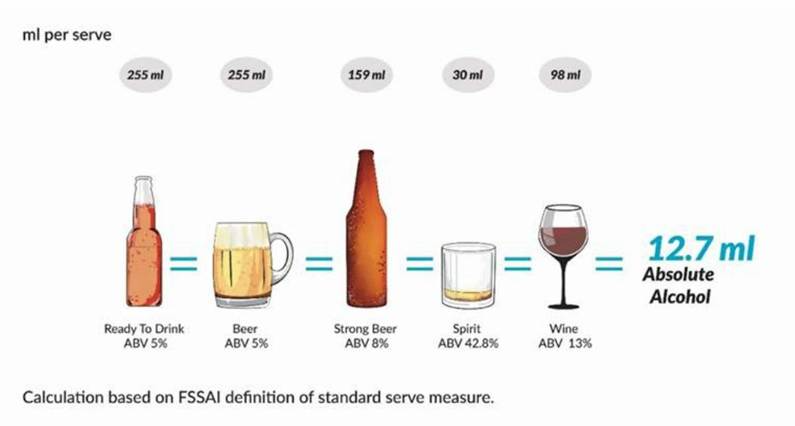
For instance, a standard 98 ml glass of wine at 13% alcohol by volume, a 30 ml serving of spirits at 42.8% ABV or a 255 ml glass of beer at 5% ABV all contain the same amount of pure alcohol.
A policy question beyond Karnataka
The Karnataka experience is particularly relevant for other States considering differential taxation or preferential treatment for AIB/Beer. The objective of an excise policy cannot be evaluated merely by showing that total revenue has increased.
Governments need to examine:
- which category is actually generating the incremental revenue
- whether the revenue increase is coming from higher consumption or higher taxation per category.
- whether a sharp increase in volumes in a preferentially taxed category is producing proportionate revenue
- whether the policy is shifting a greater tax burden onto consumers of another category
- whether the policy is consistent with the State’s broader objective of responsible alcohol consumption. Alcohol is alcohol. What is important is not what is consumed, but how much and how?
Karnataka’s Q2 numbers show that beer volumes grew nearly 50%, while IML continued to generate more than 80% of the incremental excise revenue during the period. This is an important outcome for policymakers to consider before replicating a similar AIB taxation model in other States.
The State Governments need to implement a more balanced, equitable and sustainable excise framework with the objective to support healthy growth across categories, ensure long-term revenue sustainability, and avoid disproportionate taxation of a particular category. From a policy perspective, the focus should be on overall alcohol consumption, responsible consumption, and sustainable revenue generation, rather than creating significant tax disparities between categories. A balanced excise policy that provides a more level-playing field across categories would be in the larger interest of the States and its medium to long term revenue growth and public health objectives.
For more detail, please contact Mr Sandeep Joshi, Media Consultant, CIABC (Ph. 98102 53698)
About CIABC — CIABC represents wide and inclusive interests of the Alcoholic Beverage industry. Its members include major Indian companies who manufacture and market their product range in India and abroad. As a responsible industry body CIABC regularly offers suggestions and recommendations to the State Governments for excise policies that benefit all stakeholders, i.e., the Government, the industry, and the consumers. CIABC also works with Central Government bodies such as Ministry of Food Processing Industries, Ministry of Commerce & Industry, FSSAI etc. and is proud to have played an important role in the evolution of the Governments’ positions and several regulations for alcoholic beverages.