Farmers Back Ethanol as New Agricultural Market, Seek Direct Benefits for Producers
AIKCC delegation tells Agriculture Minister Shivraj Singh Chouhan that ethanol can raise farm incomes and strengthen energy security if pricing and policy remain farmer-centric Key Highlights AIKCC farmer leaders expressed support for ethanol as a new market
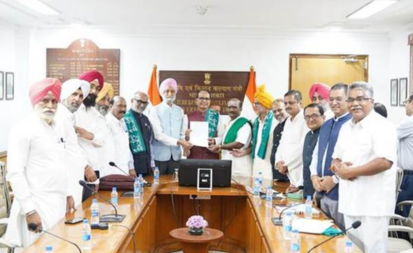
AIKCC delegation tells Agriculture Minister Shivraj Singh Chouhan that ethanol can raise farm incomes and strengthen energy security if pricing and policy remain farmer-centric
Key Highlights
- AIKCC farmer leaders expressed support for ethanol as a new market for agricultural produce.
- Farmers said ethanol could create additional demand for maize, sugarcane, rice and other feedstocks.
- The delegation called for policies ensuring that the economic benefits reach farmers rather than being concentrated among companies or intermediaries.
- Agriculture Minister Shivraj Singh Chouhan said farmer interests would remain central to ethanol policy.
- Government indicated that maize, rice, sugarcane and other feedstock markets would be reviewed to maintain a balance between demand and prices.
- The development could influence India’s future crop mix, food supply chains and agricultural commodity markets.
Farmer organisations have voiced support for India’s ethanol programme, describing the biofuel sector as a potential new market for agricultural produce while calling for policies that ensure farmers receive a fair share of the economic benefits.
A delegation of the All India Kisan Coordination Committee (AIKCC) met Union Agriculture and Farmers’ Welfare Minister Shivraj Singh Chouhan at Krishi Bhavan in New Delhi and discussed ethanol, farmers’ incomes, Minimum Support Prices (MSP), agricultural markets and the National Agriculture Policy.
The farmer representatives said they were not opposed to ethanol but viewed it as an opportunity to create additional demand for crops such as maize, sugarcane and rice.
Farmers see ethanol as an additional market
According to the farmer leaders, ethanol could expand the market available to agricultural producers beyond traditional mandi channels.
With agricultural commodities being diverted towards ethanol production, farmers could gain access to an additional buyer base, potentially reducing dependence on a single market for certain crops.
The delegation argued that ethanol production from crops such as maize, sugarcane and rice could also help address issues around crop storage and spoilage by creating additional demand.
However, the farmers stressed that the benefits would depend on whether the right price reaches producers directly.
Their message to the government was that ethanol should create a new opportunity for agriculture rather than become another source of pressure for farmers.
Demand for farmer-centric ethanol policy
A major concern raised during the meeting was the distribution of economic benefits across the ethanol value chain.
Farmer representatives said that an ethanol policy should ensure that producers receive appropriate returns for feedstocks such as maize and sugarcane rather than allowing the gains to accrue disproportionately to companies or intermediaries.
The delegation also called for greater clarity around the impact of ethanol demand on crop prices and agricultural markets.
Agriculture Minister Shivraj Singh Chouhan said the government would take the farmers’ views into consideration while reviewing ethanol-related policy.
He said the objective was to ensure that benefits flow across the chain—from the farm to the fuel tank, while keeping farmer interests at the centre.
Focus on maize, rice and sugarcane markets
The meeting also highlighted the potential effect of ethanol demand on crop allocation.
The government indicated that it would review the relationship between prices and demand for maize, rice, sugarcane and other ethanol feedstocks, with particular attention to the interests of maize farmers.
This is significant because greater industrial demand for agricultural commodities can alter planting decisions and market dynamics.
The government said decisions would be based on farmer interests and would seek to ensure that no particular crop or State is disadvantaged.
Farmers call for greater public awareness
Farmer leaders also raised concerns about what they described as misinformation and confusion surrounding ethanol.
They called for greater use of scientific studies, technical reports, farmer meetings and digital communication, including short-form videos, to explain the potential benefits and challenges associated with ethanol.
The delegation said farmers need clearer information on which crops could benefit from ethanol demand and how agricultural regions could transition towards crops that require less water where appropriate.
Potential implications for India’s food supply
The expansion of ethanol production has implications beyond the energy sector.
When crops such as maize, rice and sugarcane are used as ethanol feedstocks, changes in demand can influence the availability and pricing of commodities that also have important food and feed uses.
For the food industry, the key issue will therefore be maintaining an appropriate balance between:
food demand + feed demand + industrial demand + farmer returns.
Any significant shift in this balance could influence commodity prices and sourcing costs for food businesses.
What it means for hospitality and foodservice
For hotels, restaurants, caterers and food manufacturers, maize, rice and sugarcane are part of wider agricultural supply chains that influence ingredient and input costs.
An expanding ethanol market could create additional demand for these commodities, potentially affecting their market dynamics.
The impact will vary by crop and region. Greater demand could strengthen farm incomes and production incentives, but if industrial demand rises faster than supply, it could also place upward pressure on prices for commodities used by the food sector.
For hospitality businesses, this makes ethanol policy relevant as an indirect food-cost and procurement issue, particularly for businesses operating at large scale.
Crop diversification and water use also enter the debate
The meeting’s discussion around shifting towards less water-intensive crops is also relevant to India’s broader agricultural strategy.
Ethanol feedstocks could influence future crop choices, particularly in regions where governments are simultaneously encouraging farmers to move away from water-intensive agriculture.
The challenge will be to align biofuel demand, food security, water availability and farmer profitability rather than treating them as separate policy areas.
Wider implications for tourism and rural economies
A stronger agricultural market can have wider economic effects in rural regions, potentially supporting farm incomes, processing industries and local employment.
For rural and agri-tourism, stronger farmer incomes and agricultural value chains could contribute to more economically resilient rural destinations.
The connection to mainstream tourism, however, remains indirect and will depend on how ethanol-related agricultural changes affect regional production, incomes and local food systems.
Ethanol moves into the farm-to-food debate
The AIKCC meeting indicates that ethanol is increasingly being viewed by farmer organisations not simply as an energy policy but as an agricultural market opportunity.
The next policy challenge will be balancing additional demand for farm commodities with the needs of the food sector, water resources and farmer incomes.
For India’s food and hospitality industry, the key question will be how the growth of the ethanol economy affects the availability, pricing and sourcing of crops that sit at the intersection of the energy and food supply chains.