Government Boosts Livestock, Dairy Productivity and Animal Health Infrastructure Across India
Assam gets support for pig breeding and pork processing, while higher milk productivity, fodder security and animal disease control strengthen India’s livestock supply chain Key Highlights ₹4.98 crore subsidy released for 50 livestock projects in Assam, including
Assam gets support for pig breeding and pork processing, while higher milk productivity, fodder security and animal disease control strengthen India’s livestock supply chain
Key Highlights
- ₹4.98 crore subsidy released for 50 livestock projects in Assam, including 23 pig breeding farms
- ₹1.80 crore sanctioned for a Pig Semen Collection and Processing Laboratory in Assam
- India’s average bovine milk productivity rises from 1,648 kg to 2,251 kg per animal annually
- National milk production increases 70% to 248 million metric tonnes
- ₹1,152.40 crore released for fodder development over the last five years
- 174 animal feed plants supported under AHIDF with investments of ₹3,602.47 crore
- 100 Fodder-Plus Farmer Producer Organisations established by NDDB
- 9,92,863 Classical Swine Fever vaccinations administered free of cost in Assam
New Delhi, August 5, 2026: The Government is expanding support for India’s livestock and dairy sectors through investments in scientific breeding, animal health, fodder security, processing infrastructure and livestock entrepreneurship.
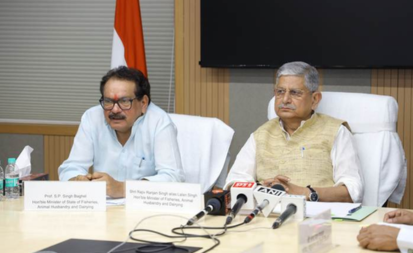
Union Minister for Fisheries, Animal Husbandry and Dairying Rajiv Ranjan Singh alias Lalan Singh informed the Rajya Sabha that programmes including the National Livestock Mission (NLM), Animal Husbandry Infrastructure Development Fund (AHIDF), Rashtriya Gokul Mission (RGM) and Livestock Health & Disease Control Programme (LHDCP) are being used to strengthen the sector and support rural livelihoods.
Assam Gets Push for Pig Breeding and Processing
Livestock entrepreneurs in Assam are receiving assistance to establish modern pig breeding farms and pork processing facilities.
During the last three years, ₹4.98 crore in subsidies has been released for 50 livestock projects under the NLM’s Entrepreneurship Development Programme, including 23 pig breeding farms.
Under AHIDF, another ₹1.44 crore has been released as interest subvention for eight projects, including a pig breeding farm.
The Government has also sanctioned ₹1.80 crore for a Pig Semen Collection and Processing Laboratory in Assam. The facility is aimed at promoting artificial insemination and genetic improvement in pig farming.
Animal health remains a key focus, with 9,92,863 Classical Swine Fever vaccinations administered free of cost in Assam.
The measures are also expected to support employment generation and improve the state’s potential for pork production and exports.
India’s Milk Productivity Continues to Rise
India’s dairy sector has recorded significant growth over the past decade.
According to the Government, average bovine milk productivity increased from 1,648 kg per animal per year in 2014-15 to 2,251 kg in 2024-25.
National milk production has also increased by 70%, rising from 146 million metric tonnes to 248 million metric tonnes during the same period.
For the foodservice and hospitality sector, rising milk production has significance across a wide range of categories, from fresh dairy and bakery products to desserts, beverages, breakfast offerings and commercial kitchens.
Fodder Security Becomes a Key Priority
The Government is also focusing on the availability of quality fodder to support livestock productivity.
Under the National Livestock Mission, ₹1,152.40 crore has been released over the last five years, resulting in the production of around 1.6 lakh tonnes of quality fodder seed.
A total of 204 fodder-related projects have been approved under the NLM Entrepreneurship Development Programme.
Meanwhile, AHIDF has supported 174 animal feed plants, involving investments of ₹3,602.47 crore.
The National Dairy Development Board has established 100 dedicated Fodder-Plus Farmer Producer Organisations, while the ICAR-Indian Grassland and Fodder Research Institute has developed high-yielding forage varieties and state-specific fodder development plans.
More than 10 lakh farmers have also been trained under related initiatives.
Heatwave Management and Digital Dairy Advisory
With rising temperatures posing challenges for livestock productivity, the Government has issued heatwave management guidelines to States and Union Territories.
It is also promoting indigenous cattle breeds known for their resilience to high temperatures.
Farmers are being provided digital advisory support through the 1962 Farmers App under Bharat Pashudhan, including guidance on scientific ration balancing.
Animal Disease Control Strengthened
Under the National Animal Disease Control Programme, implemented as part of the Livestock Health & Disease Control Programme, the Government provides 100% Central assistance for vaccination against Foot and Mouth Disease (FMD) and Brucellosis.
Disease prevention and veterinary infrastructure are critical not only for livestock productivity but also for maintaining stability across animal-derived food supply chains.
What It Means for Hospitality, Food and Tourism
The latest measures have a direct connection with India’s food, beverage and hospitality ecosystem.
Higher milk productivity and increased feed and fodder infrastructure can strengthen the availability of dairy inputs used by hotels, restaurants, cafés, bakeries, caterers and food manufacturers.
The development of organised pig breeding and pork processing in Assam could also support the growth of regional pork-based cuisine and destination food experiences, particularly in Northeast India where pork features prominently in local culinary traditions.
For hospitality businesses, stronger livestock health systems can improve supply-chain resilience and reduce risks associated with animal disease disruptions. Improved breeding, processing and cold-chain infrastructure can further encourage more organised sourcing of meat and dairy products.
From a tourism perspective, livestock and dairy development can also contribute to rural tourism, farm experiences and regional culinary tourism, particularly when local producers and traditional food products are integrated into destination experiences.
Bottom Line: The Government’s latest livestock measures combine productivity enhancement with breeding, fodder security, processing and disease control. For India’s hospitality and foodservice industry, the developments could strengthen the availability and resilience of key animal-derived food supplies while opening opportunities for regional culinary and rural tourism.